Exploring Income Opportunities – What Can You Realistically Do?
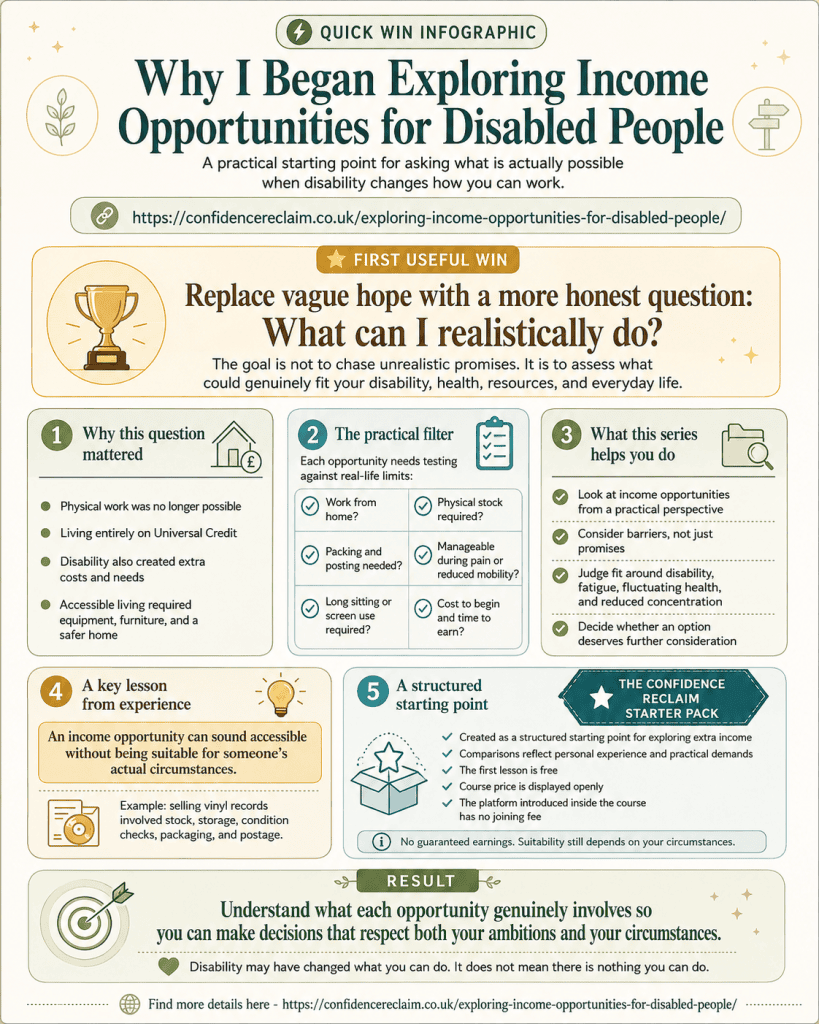
Exploring Income Opportunities – What Can You Realistically Do – Infographic
Save this handy infographic for when you need it in the future

Save this handy infographic for when you need it in the future
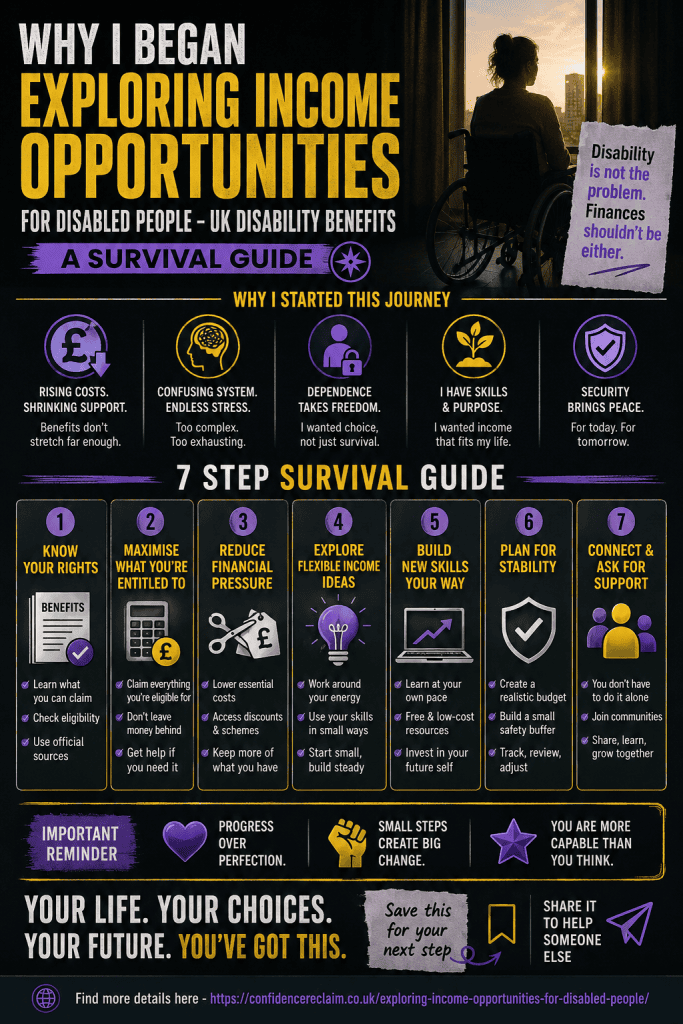
Save this handy info graphic for when you need it
There came a point in my life when I had to ask a very practical question:
I had previously been able to carry out physical work. When that was no longer possible, I found myself living entirely on Universal Credit.
The problem was that my disability had not only reduced my ability to earn. It had also created additional costs and needs.
I required equipment, suitable furniture and a home that I could move around safely. The property I was living in was up two flights of stairs with no lift. Inside the house, I also needed to use stairs to reach the bathroom and toilet.
Eventually, I became largely housebound.
At the time, I was using two crutches and could barely walk 50 feet. I could not go out and do my own shopping. I depended heavily on other people for help. Even sitting down for any length of time could be uncomfortable. That was not something I ever expected to happen to me.
It became clear that I needed to move somewhere more suitable.
I eventually moved into a ground-floor flat with a walk-in shower.
It was far more suitable for my mobility, but I had no money to pay for the move. My savings had already been eaten away by the additional costs associated with my disability, so I had to borrow money from a friend.
The flat had bare concrete floors and damaged, undecorated walls.
I was physically unable to paint or decorate it myself. I also could not afford to pay someone else or buy suitable floor coverings.
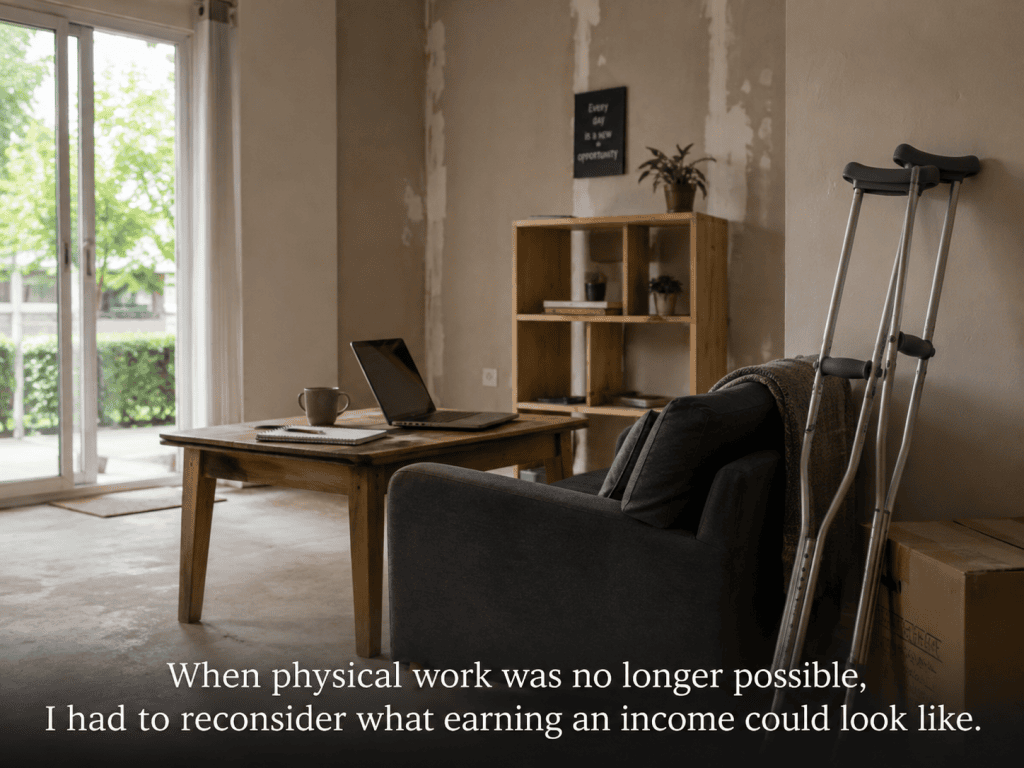
Living in those conditions affected my mental health. I felt depressed and increasingly downbeat. I had moved into a home that was more accessible, but I did not have the money or physical ability to make it comfortable.
At one point, I tripped on the concrete floor and injured my leg.
Falling is frightening when you have limited mobility. Getting back up was extremely difficult.
After I told my friend what had happened, she offered to lend me more money so I could buy floor coverings. I was grateful, but I was also becoming increasingly aware of how dependent I had become.
I already owed money for the move. Now I owed more money simply to make the flat safe enough to live in.
That experience reinforced something I already knew.
I needed to find a realistic way to earn extra income. I also found that earning or making extra money while claiming disability benefits is not as easy as it should be.
I was not looking to start chasing unrealistic promises or to find some magical answer.
I needed to understand what I could genuinely do within the limits created by my disability.
Could the work be done from home?
Would it require physical stock?
Would I need to pack and post products?
Could I manage it during periods of pain or reduced mobility?
Would it require long periods of sitting, concentration or screen use?
How much would it cost to begin?
How long might it take before there was any possibility of earning money?
These questions led me to begin examining different income opportunities.
Some appeared attractive at first.
Selling vinyl records, for example, seemed like a possible way to earn extra income. Once I looked more closely, I found that it involved buying stock, storing records, checking their condition, packaging orders and arranging postage.
Those demands made it far less suitable for me than it had first appeared.
That experience taught me an important lesson.
An income opportunity can sound accessible without being suitable for someone’s actual circumstances.
This series is for people with a disability who may be asking the same question I had to ask:
I will look at different opportunities from a practical perspective.
I will not only ask whether someone, somewhere, has made money from them. I will consider what the work involves, what barriers may arise and whether the opportunity could reasonably fit around disability, limited mobility, fluctuating health, fatigue or reduced concentration.
No opportunity will be right for everyone.
Two people with the same diagnosis may have completely different abilities, needs and restrictions. What works well for one person may be unmanageable for another.
The purpose of these articles is not to tell you what you must do.
It is to help you understand the practical demands of each opportunity so you can decide whether it deserves further consideration.
Disability can affect far more than physical ability.
It can change how you see yourself.
When work, independence and ordinary routines are taken away, it is easy to begin focusing only on what you can no longer do. This is disabling in and of itself.
That is one reason I am careful about how opportunities are introduced.
People sometimes reject an idea as soon as they encounter one unfamiliar word, example or task. They decide that they are not knowledgeable enough, technical enough or confident enough before they have properly understood what is involved.
I do not want to add to that sense of limitation.
I want to present possibilities clearly, honestly and in a way that will allow you to consider them without becoming overwhelmed.
That does not mean pretending that every opportunity is easy.
We all know extra income does not simply appear. Earnings cannot be guaranteed and some opportunities will not suit a person’s health, interests or circumstances.
But you should have the chance to assess the real opportunity, rather than rejecting it because of an assumption.
I created ‘The Confidence Reclaim Starter Pack’ as a structured starting point for people who want to explore a possible route towards extra income.
Where articles in this series compare other opportunities with ‘The Confidence Reclaim Starter Pack,’ I will make that connection clear. The comparisons reflect my personal experience, the practical demands I identify and my assessment of suitability. They do not represent guaranteed earnings.
You will find that the course price is displayed openly. The lesson structure can be reviewed before purchase and the first lesson is available free, allowing you to experience the approach before deciding whether to continue.
The platform introduced inside the course has no joining fee.
I recognise that ‘The Confidence Reclaim Starter Pack’ may not be suitable for everyone. It still requires desire, some time and a willingness to follow the process.
The question behind this series is not simply:
For almost any opportunity, somebody will be able to say yes.
The more useful question is:
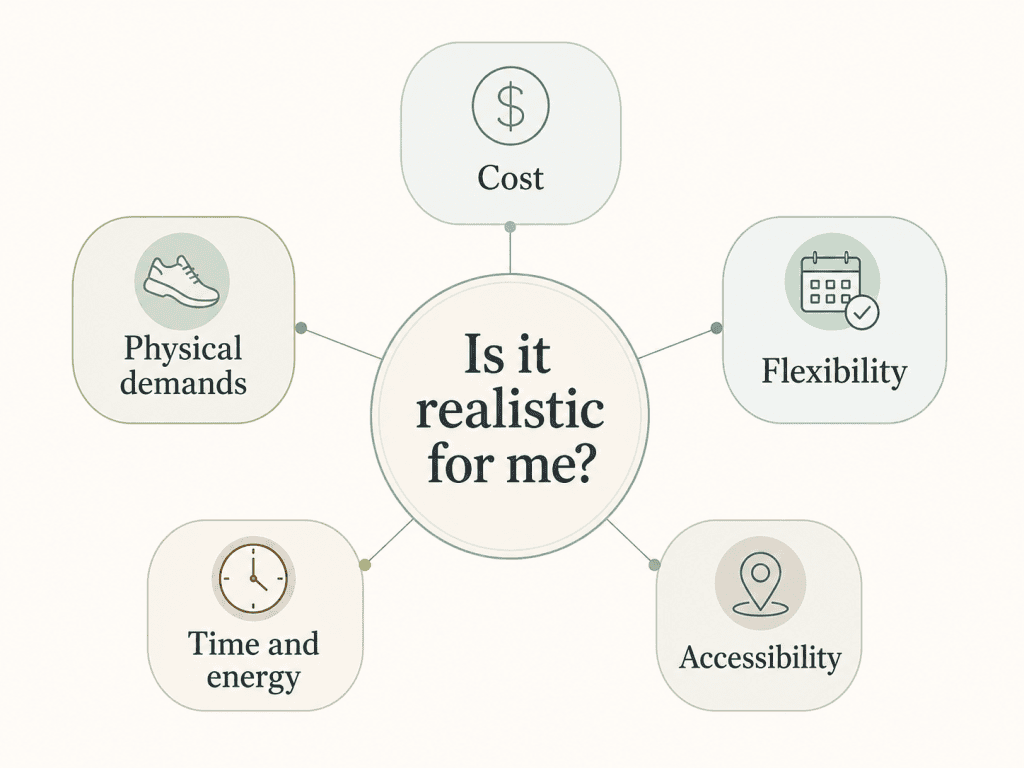
That is the question I needed answered.
It is the question I will continue asking throughout this series.
My hope is that these articles help you look beyond attractive claims, understand what each opportunity genuinely involves and make a decision that respects both your ambitions and your circumstances.
Disability may have changed what you can do.
It does not mean there is nothing you can do.
Ambition can still hold a place in your life.

Stephen Wilk
‘The Confidence Reclaim Starter Pack’ was born when I found myself struggling with disability.
I created ‘The Confidence Reclaim Starter Pack’ to help others who might be facing the same or similar challenges that I did.
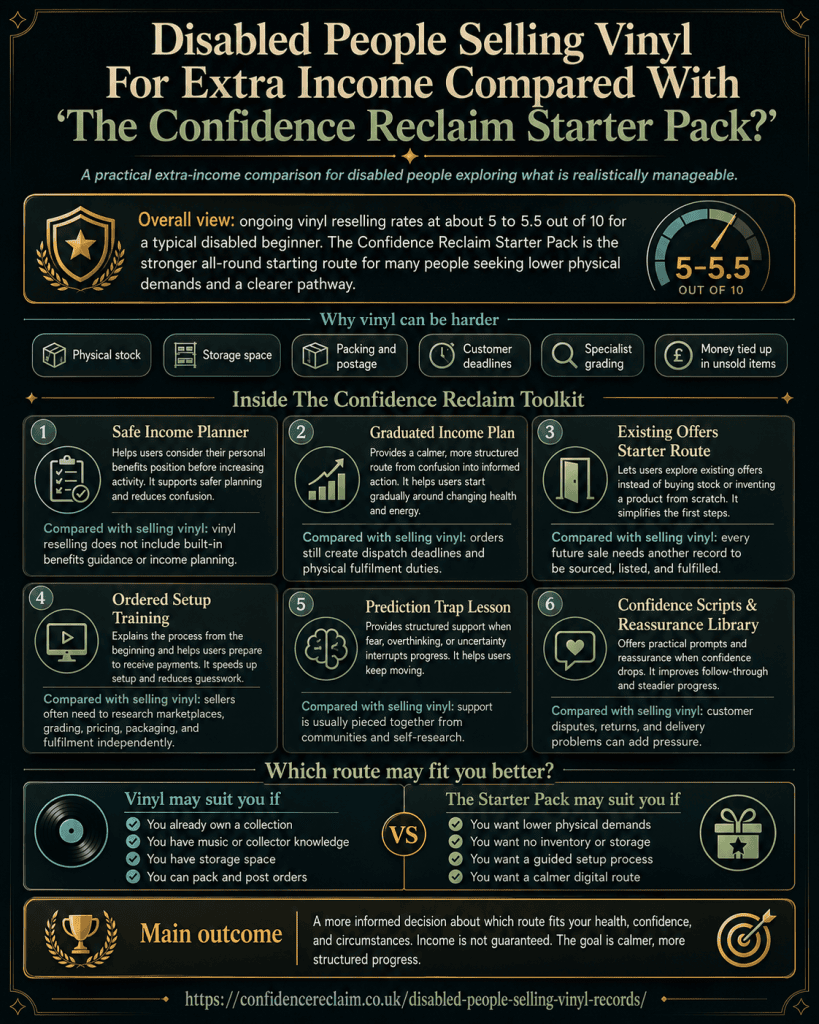
Use this handy infographic to help you compare selling vinyl records with ‘The Confidence Reclaim Starter Pack’ as extra income opportunities
Selling vinyl records can provide useful extra income for some disabled people, particularly those who already own a collection, understand the market or can access suitable stock at low prices.
However, building an ongoing vinyl resale activity involves more than placing records online. It requires sourcing, identifying, grading, storing, packing and posting physical products.
For a disabled person asking, “What can I do to earn extra income?”, vinyl selling is a possible option, but its suitability depends heavily on health, mobility, available space, specialist knowledge and access to affordable records. For many beginners, a guided digital opportunity such as ‘The Confidence Reclaim Starter Pack’ may present fewer practical barriers.

When disability changes what you can do for work, the first question is not always:
Often, it is:
You may need something that can fit around pain, fatigue, medical appointments, anxiety or a condition that changes from one day to the next.
You may be able to work for short periods, but not guarantee fixed hours.
You may want to earn extra income, but need to understand the demands of an opportunity before investing your energy, money or confidence in it.
This is why generic lists of side-income ideas are not enough.
An opportunity may sound flexible but still require travel, lifting, storage, customer deadlines or money tied up in stock.
The right question is not simply whether someone can make money selling vinyl records.
The better question is:
Could selling vinyl records realistically work around my disability and personal circumstances?
It is important to separate two activities that are often treated as though they are the same.
You may have records stored at home that you no longer use.
They may belong to you, have been inherited or form part of a collection you now want to reduce.
Selling these records can create a useful one-time sum of money.
Because you already own the stock, you do not need to spend money sourcing products before you begin. Your main tasks will include:
This can be a reasonable option if the records are desirable and in suitable condition.
However, once the collection has been sold, that source of income ends.
Selling an existing collection is therefore better understood as converting an asset into money, rather than building a continuing income activity.
An ongoing vinyl business operates differently.
You must repeatedly find records at a price low enough to leave a profit after selling costs.
Possible sourcing routes include charity shops, car boot sales, record fairs, online auctions, house clearances and private collections.
This creates the central difficulty.
The records that are easiest to obtain are not always the records buyers want. Common titles may sell slowly or produce little profit after fees, postage and packaging.
More desirable records are harder to find. Other sellers may already be searching the same charity shops, sales and online listings.
The viability of an ongoing resale activity therefore depends less on whether vinyl is popular and more on whether you can secure a reliable supply of worthwhile stock.
Selling vinyl is often described as an online or home-based opportunity.
That is only partly true.
The listing and research can usually be completed from home. The complete process may also involve physical and time-sensitive tasks.
Different editions of the same album can have very different values.
A seller may need to check:
This requires close attention to detail.
Collectors expect records to be graded accurately.
A record may appear clean but contain scratches, surface noise or warping. The sleeve may have creases, splits, water damage or missing inserts.
Grading can be subjective. A buyer may disagree with the description and request a return or refund.
Visual impairments, difficulties with concentration or conditions affecting detailed handling may make this stage more demanding.
Records may need to be cleaned before they are assessed and listed.
Clear photographs are also important. Buyers may want to see the sleeve, labels, inserts and any defects.
Vinyl records are physical products.
They require suitable storage and can become heavy when stored in boxes or larger collections.
A continuing resale activity may require space for:
This may be difficult in a small home or where clear space is needed for mobility equipment.
Vinyl requires protective packaging.
Once an order is placed, the work becomes less flexible. The seller has made a commitment to locate, pack and dispatch the record within the promised period.
Someone with fluctuating health may be able to pause research and listing. It is harder to pause when a buyer is waiting for an order.
Vinyl selling does have genuine strengths.
Research, photography and listing do not always need to happen at the same time.
Someone may be able to work in short periods according to their energy.
Online marketplaces allow sellers to reach buyers without running a shop or market stall.
A person who already understands artists, genres, labels or collectible pressings may have a strong advantage.
Where the stock is already owned, there is no need to purchase inventory before making the first sale.
Some people prefer handling real items rather than working entirely through digital systems.
These strengths mean vinyl selling should not be dismissed.
For the right person, it may be enjoyable and worthwhile
The research also reveals several important limitations.
An ongoing seller needs a continuing supply of records that buyers want.
Cheap stock may be common, damaged or slow to sell. Better stock usually attracts more competition and costs more.
Buying records creates a financial risk before any sale occurs.
Some items may sell quickly. Others may remain listed for months or fail to sell at the expected price.
Earnings depend on what stock is available, what buyers want and how long each record takes to sell.
A valuable record may produce a strong return, but common records may create very little net income after costs.
Once a record is sold, it is gone.
To make the next sale, another record must be sourced, researched, listed and fulfilled.
Travel, lifting boxes, searching through crates, cleaning records, packing orders and visiting postal services may all be involved.
Profitable reselling often depends on knowing which editions, labels and pressings are worth buying.
A beginner can learn this, but it takes time.
Arguments about condition, shipping damage, delayed delivery or incorrect identification can add stress to what initially appeared to be a quiet home-based activity.
Vinyl reselling may suit someone who:
It may be less suitable for someone who:
The uploaded assessment gives ongoing vinyl reselling an overall viability rating of approximately 5 to 5.5 out of 10 for a typical disabled beginner.
Selling an existing personal collection may rate higher as a one-time activity because there is no need to source new stock.
I created ‘The Confidence Reclaim Starter Pack’ for disabled people and people with long-term health conditions who want to explore additional income but need a calmer and more structured way to begin.
The Starter Pack first helps the user consider their personal benefits position.
It then introduces a flexible online offer-promotion opportunity and guides the user through the practical setup stages.
The aim is not to promise income or suggest that every opportunity will suit every person.
It is to help the user move from confusion into informed action.

|
Comparison question |
Selling vinyl records |
The Confidence Reclaim approach |
|
Can it fit around changing health? Why it matters: A disabled person may not have the same capacity every day. |
Research, photography and listing can be flexible. Once an order is placed, the seller must pack and dispatch it within the promised period. |
Learning and setup can be completed gradually, according to the user’s available time and energy. |
|
Can the activity be completed from home? Why it matters: Travel may be difficult, exhausting or impossible for some people. |
Most selling activity can happen online. Sourcing records and taking parcels to a postal service may still require travel. |
The opportunity is primarily online and does not depend on visiting shops, record fairs or car boot sales. |
|
Is physical handling required? Why it matters: Lifting, cleaning, packing and moving products may create barriers. |
Records must be inspected, cleaned, stored, packed and posted. Boxes of vinyl can also become heavy. |
No physical stock, product cleaning, packing or postal fulfilment is required. |
|
Is startup money needed? Why it matters: Spending money before earning can create financial pressure. |
Selling an existing collection may involve little initial cost. Ongoing reselling usually requires money for stock, packaging, cleaning materials and travel. |
Users do not need to purchase physical inventory before they can begin exploring existing offers. |
|
Is a continuing supply of stock required? Why it matters: Income may stop when suitable products cannot be found at a profitable price. |
Every future sale requires another record to be sourced. Affordable and desirable stock can be difficult to find consistently. |
The opportunity does not depend on repeatedly finding physical products below their market value. |
|
Is storage space needed? Why it matters: Stock can occupy living space and may need special storage conditions. |
Space is required for records, packaging materials, cleaning equipment and items waiting to be dispatched. |
No physical product storage is required. |
|
Is specialist knowledge required? Why it matters: A long learning curve may delay progress and increase the risk of mistakes. |
Pressing identification, grading, pricing and collector knowledge can be important, particularly when buying stock to resell. |
The Starter Pack explains the process from the beginning and does not assume previous business experience. |
|
Does the user need to invent or create a product? Why it matters: Creating an original product or business idea can stop someone before they begin. |
The seller must find, assess and prepare a suitable physical product for every sale. |
Existing offers can be explored, so the user does not need to invent a product from nothing. |
|
Does each payment require a new item or task? Why it matters: Some income models begin again from zero after every transaction. |
Once a record is sold, another record must be sourced, researched, listed and fulfilled. |
An offer can remain available after its initial setup, although continued promotion and effort may still be required. |
|
Is the setup process guided? Why it matters: Disconnected information can create confusion and delay action. |
The seller will usually need to research marketplaces, grading, pricing, packaging and fulfilment independently. |
The course provides an ordered setup process and helps users prepare to receive payments. |
|
How predictable is the income? Why it matters: Irregular income can make financial planning difficult.
|
Income depends on stock availability, condition, buyer demand and how long each record takes to sell. |
Income is not guaranteed, but activity is not limited by the need to find and purchase a new physical item for every sale. |
|
Are customer service and fulfilment obligations involved? Why it matters: Returns, disputes and delivery problems can add pressure.
|
The seller may need to deal with grading disputes, damaged parcels, late deliveries, refunds and returns. |
There is no physical delivery or product grading, although users must still follow platform rules and communicate responsibly. |
|
Can the activity grow without an equal increase in physical work? Why it matters: Some opportunities require more stock, storage and handling as sales increase. |
Growth usually means sourcing, storing, packing and posting more records. It may also require more working capital. |
Digital offer promotion can grow without an equivalent increase in physical fulfilment, although active work is still required. |
|
Does the opportunity include benefits planning? Why it matters: Extra income should be considered alongside the user’s individual benefits position.
|
Vinyl reselling does not provide built-in benefits guidance or income planning. |
The Safe Income Planner and Graduated Income Plan help users consider their position before increasing activity. |
|
What support is available when confidence drops? Why it matters: Fear and uncertainty can interrupt progress even when the practical route is clear. |
Support depends on the marketplace, seller communitiesor informationthe individual finds independently. |
The free Prediction Trap lesson and Confidence Scripts and Reassurance Library provide structured support. |
Selling vinyl records can be a good choice in certain circumstances.
If you already own a worthwhile collection, selling it may produce useful one-time income.
If you have detailed music knowledge, suitable storage and an established way to obtain undervalued stock, you may also be able to develop an ongoing resale activity.
However, for a typical disabled beginner seeking a flexible supplementary income route, vinyl selling has several structural barriers:
The Confidence Reclaim route removes many of those barriers.
It does not require physical inventory, storage, cleaning or postal fulfilment.
It also begins with personal planning and a guided setup process rather than leaving the user to assemble the route alone.
For these reasons, I consider The Confidence Reclaim Starter Pack the stronger all-round starting opportunity for many disabled people who want to explore extra income with lower physical demands and a clearer pathway.
That does not mean it is automatically right for everyone.
The purpose of the comparison is to help you understand the differences, consider your own circumstances and make a more informed decision.
Before beginning any income activity, ask:
The best opportunity is not necessarily the one with the most exciting income claim.
It is the one you can realistically begin, continue and manage around your life.
I created The Confidence Reclaim Starter Pack because I know what it feels like when disability changes your working life, income, confidence and sense of control.
The Starter Pack is designed to help people who want to explore extra income begin with clearer information, practical tools and manageable steps.
[Read what The Confidence Reclaim Starter Pack is and who it is for]
From there, you can decide whether it offers a better fit for your circumstances.
The Confidence Reclaim Starter Pack provides educational guidance, planning tools and practical structure. It does not guarantee earnings or replace qualified welfare rights, legal, financial, tax or benefits advice.
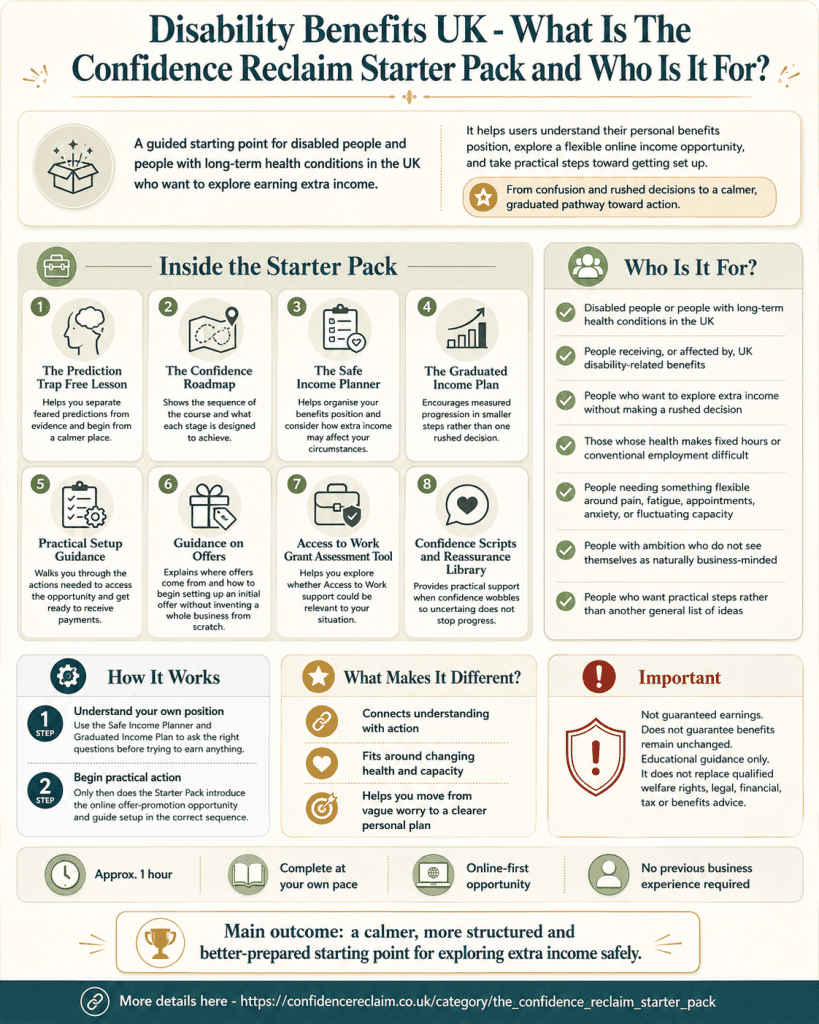
Who Is It For And How This Can Help If You Are Claiming Disability Benefits
Use this handy infographic to help you understand what ‘The Confidence Reclaim Starter Pack’ is and who it is for.
The Confidence Reclaim Starter Pack is a guided starting point for disabled people and people with long-term health conditions in the UK who want to explore earning extra income.
It helps users understand their personal benefits position before introducing a flexible online income opportunity and the practical steps needed to begin.
The aim is to replace confusion and rushed decisions with a calmer, graduated pathway toward action.
The Confidence Reclaim Starter Pack is a guided starting point for disabled people and people with long-term health conditions in the UK who want to explore earning extra income.
I created it for people who have ambition, curiosity or a need for more financial breathing space, but feel uncertain about what they can safely and realistically do.
It combines three things that are often treated separately:
The Starter Pack is not simply a list of possible jobs or money-making ideas.
It is a structured pathway.
It helps you slow the process down, ask the right questions and take one step at a time. The aim is to replace guessing and fear with clearer information, practical action and greater control over your next decision.

I know what it feels like when disability changes your working life, income, confidence and sense of control.
One minute, the way you work makes sense.
Then your health changes.
What you can do changes. Your income may become less certain. Everyday decisions can start to feel heavier than they did before.
You are not only dealing with the effects of disability. You may also be dealing with benefit rules, assessments, paperwork, financial pressure and a difficult question:
I found that a great deal of information explains benefit rules, what someone may be able to claim and what they must report.
That information matters.
But once you have read it, the personal question can remain unanswered:
That is the gap I created The Confidence Reclaim Starter Pack to address.
My aim is not to push disabled people into work.
It is not to suggest that every person can work, should work or must turn themselves into a business owner.
It is for people who already want to explore change and need a calmer, more structured way to begin.
The Confidence Reclaim Starter Pack may be suitable for you when:
Many disabled people cannot promise that every day will be the same.
There may be good days, bad days and days when very little is possible.
That means an opportunity should fit around the person. The person should not have to force their health around the opportunity.
The Starter Pack is not designed to persuade someone who does not want to explore income.
It is not a promise of guaranteed earnings.
It does not guarantee that benefits will remain unchanged.
It is not a replacement for qualified welfare rights, legal, financial, tax or benefits advice.
It is also not an instant route to financial independence. It provides a starting structure, planning tools and practical actions. The results will depend on the person, the time they can contribute, the actions they take and their individual circumstances.
There is no single income figure that is safe or appropriate for everyone.
Benefits, household circumstances, existing awards, housing support, health status and the type of income being considered may all affect the position. This is why personal checking matters before decisions are made.
The Starter Pack uses a two-stage approach.
The first stage begins before you try to earn anything.
It helps you look at your current circumstances and ask the questions that apply to you.
Different benefits have different conditions. Two people with similar disabilities may have different household circumstances, different awards and different considerations.
The Safe Income Planner helps you organise the relevant information and develop a clearer view of your own position.
The Graduated Income Plan then helps you think in steps rather than treating income as an all-or-nothing decision.
The purpose is not to produce a universal answer.
It is to help you move from vague worry toward a more informed personal plan.
You should still check your conclusions with an appropriate adviser before making decisions that could affect your benefits or financial position.

Only after considering your position does the Starter Pack introduce the online income opportunity.
The opportunity involves promoting useful offers to people who may benefit from them.
The basic idea is familiar.
Most of us have recommended a film, product, service, restaurant or useful resource to someone. Online offer promotion develops that everyday act of recommendation into a structured activity.
The external platform is introduced inside the course.
I have chosen not to name it on this page.
That is deliberate.
Searching for the platform independently can lead people into a large amount of information before they understand the correct setup process. Important steps can be missed and the person can lose sight of what they were originally trying to achieve.
The Starter Pack introduces the platform at the appropriate stage. It then helps the user work through the setup process, prepare to receive payments and begin creating their first opportunity.
This matters because completing the steps produces something more valuable than passive information.
It gets the user moving.
A person is no longer only reading about change. They are taking positive action toward it.

The current Starter Pack includes:
This introductory lesson is designed for people who feel cautious, stuck or afraid of losing something they depend on.
It explains how the mind can begin treating feared predictions as though they are proven facts. It introduces simple ways to separate a forecast from evidence and begin approaching decisions from a calmer place.
The roadmap helps the user understand the sequence of the course and what each stage is intended to achieve.
This planning tool helps users organise information about their position and consider how additional income might interact with their existing circumstances.
It is a planning aid, not a benefits decision or guarantee.
The Graduated Income Plan encourages measured progression.
Instead of assuming someone must make one large decision, it helps them think through smaller stages. The user can review what is happening, build experience and decide what to do next from a more informed position.
The course takes the user through the actions needed to access the opportunity, easily set up the relevant structure and prepare to receive payments.
The external platform and personal invitation are provided at the appropriate point in the course.
The Starter Pack explains where offers come from, how the promotion model works and how a user can begin setting up an initial offer.
This can remove one of the biggest barriers faced by someone who does not feel business-minded.
You do not have to begin by inventing an entirely new company, developing a product from nothing or trying to work out what to sell. The opportunity already provides offers that can be explored and promoted.
The assessment tool guides users through questions that may help them understand whether Access to Work support grant could be relevant to their circumstances.
It is intended to make the initial exploration clearer and less overwhelming. It does not make an official eligibility decision.
This library provides practical support for moments when confidence starts to wobble.
It is designed to help the user return to the facts, remember why they began and continue without turning temporary uncertainty into a final decision.

The course itself can take approximately one hour to complete.
There is no requirement to finish it in one sitting.
You can divide it into smaller sections and work through it according to your energy and capacity. There is no fixed timetable.
The purpose of the structure is to reduce the time and confusion involved in trying to find, compare and organise all the relevant information independently.
The underlying research and setup can be completed without the Starter Pack. However, the course material estimates that finding the correct route and working through the setup independently could take several days, with a greater chance of overlooking an important step.
The Confidence Reclaim Starter Pack is not the only possible route to additional income.
Someone might consider surveys, blogging, reselling products, freelance services, remote employment or other online opportunities.
The right comparison is not simply:
A more useful comparison considers whether the opportunity fits the person’s actual life.
Comparison question | Why it matters | The Confidence Reclaim approach |
Can it fit around changing health? | Fixed schedules may not suit fluctuating capacity. | The pathway can be followed gradually and at the user’s pace. |
How complicated is the setup? | Too many disconnected steps can create confusion. | The course organises setup into a guided sequence. |
Is a new business idea required? | Inventing a product or service can become an immediate barrier. | Existing offers can be explored before creating original offer combinations. |
Is the work paid once or can it keep producing value? | Some tasks end as soon as payment is received. | An offer created within the platform may continue working after the initial setup. |
What physical demands are involved? | Mobility, pain and fatigue may rule out some activities. | The opportunity is primarily online. |
How quickly can someone begin taking action? | Endless research can delay progress. | The Starter Pack focuses on getting the user organised and ready to act. |
Does it include benefits planning? | Income cannot be considered separately from individual circumstances. | The Safe Income Planner and Graduated Income Plan come before scaling activity. |
Is specialist business experience required? | Many people have ambition without a business background. | The course explains the process from the beginning. |
What support is available when confidence drops? | Fear can interrupt action even when the practical route is clear. | The free lesson and reassurance resources address this directly. |
This framework will also be used in separate articles comparing the Starter Pack with individual opportunities.
Each comparison should consider both advantages and disadvantages.
The purpose is not to declare that one route is automatically best for everyone. It is to help disabled people judge opportunities against their health, circumstances, goals and tolerance for uncertainty.
A great deal of disability income content starts and ends with regulations or a short list of ideas.
The Confidence Reclaim Starter Pack goes further.
It connects understanding with action.
It helps the user consider their personal position, introduces a specific opportunity and guides them through the practical steps needed to begin.
That is the central difference.
Information can tell you that options exist.
A pathway helps you take the next step.
You do not have to decide everything today.
You do not need to prove anything to anyone.
You can begin by understanding why I created The Confidence Reclaim Starter Pack and what I experienced when disability changed my own working life.
Read my story and learn why I created Confidence Reclaim
From there, you can decide whether the next step feels right for you.
The Confidence Reclaim Starter Pack provides guidance, structure and educational tools. It does not replace qualified welfare rights, legal, financial, tax or benefits advice. Always check your own circumstances carefully before making decisions.
If you are ready to find out more about this exciting opportunity – Read my story and learn why I created Confidence Reclaim

The Confidence Reclaim Starter Pack is a guided course and set of planning tools for disabled people and people with long-term health conditions in the UK who want to explore earning extra income.
It helps users begin by considering their own benefits position. It then introduces a flexible online income opportunity and guides them through the practical steps needed to get set up and ready to receive payments.
It is designed to turn information into positive action, one manageable step at a time.
The Starter Pack is for people who want to explore additional income but need an approach that can fit around disability, fluctuating health, fatigue, pain, appointments or changing capacity.
It may also suit someone who has ambition but does not consider themselves business-minded.
The course does not assume that every disabled person can work or should be encouraged into work. It is for people who already want to explore change and would benefit from a calmer, more structured starting point.
No.
The Confidence Reclaim Starter Pack provides educational guidance, planning tools and a structure for asking the right questions.
It does not replace qualified welfare rights, legal, financial, tax or benefits advice. Users should always check their own circumstances before making decisions that could affect their income or benefits.
No.
There is no single safe income figure that applies to everyone.
The effect of earnings may depend on the benefits you receive, your household circumstances, housing support, existing awards and whether the income comes from employment or self-employment.
The Safe Income Planner and Graduated Income Plan are designed to help you understand the questions that apply to your situation. They do not guarantee a particular benefits outcome.
No previous business experience is required.
One of the biggest barriers to starting something independently is deciding what to offer, how to set it up and how payments will work.
The Starter Pack breaks the process into practical steps. The external platform already contains offers that users can explore, which means they do not have to begin by inventing a completely new product or business idea.
The platform is introduced inside the course at the stage when the user is ready to set it up correctly.
This is deliberate.
Searching for the platform too early can lead someone into a large amount of disconnected information. They may miss an important step, become overwhelmed or lose sight of what they were originally trying to achieve.
The Starter Pack is designed to guide the user through the correct sequence, prepare them to receive payments and help them begin taking practical action in the shortest reasonable time.
The current Starter Pack includes:
The course also provides access to the external platform at the appropriate stage.
The Prediction Trap is the free introductory lesson.
It is designed to help people notice when fear is being treated as proof. It explains how the mind can predict a negative outcome before all the facts are known and introduces simple ways to separate a forecast from evidence.
The lesson provides a calm first step before the practical income planning and setup stages begin.
The course can take approximately one hour to complete.
You do not have to complete it in one sitting.
You can work through it in smaller sections, according to your health, energy and available time. There is no fixed deadline.
The course was designed with fluctuating health in mind.
Many disabled people cannot commit to fixed hours or guarantee the same level of capacity every day. The Starter Pack allows users to move through the material and explore the opportunity at their own pace.
The aim is for the process to fit around the person, rather than forcing the person to fit around a rigid schedule.
No.
The Starter Pack provides guidance, planning tools, access to an opportunity and practical setup steps.
It cannot guarantee income. Results will depend on the user’s circumstances, the actions they take, the time they can contribute and how they apply what they learn.
The purpose is to help someone begin from a clearer and better-prepared position.
Some income activities involve completing one task and receiving one payment.
The opportunity introduced through the Starter Pack allows users to create an element within the platform that may continue working after the initial setup. This creates the possibility of building activity over time rather than starting again from zero for every payment.
That does not make it automatically better for every person. Any opportunity should be compared according to flexibility, setup requirements, physical demands, earning potential and how well it fits the person’s circumstances.
A good first step is to read the founder’s story.
It explains why I created The Confidence Reclaim Starter Pack, what I experienced when disability changed my own working life and why I believe people need a calm pathway rather than more pressure.
From there, you can decide whether to explore the free lesson or the full Starter Pack.
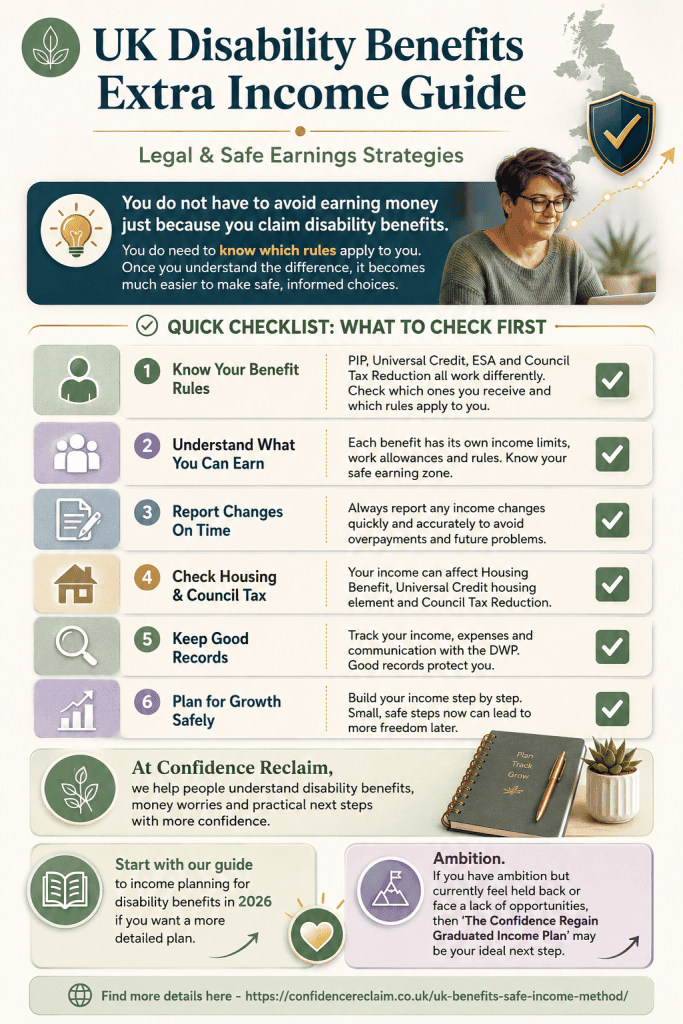
Use this handy infographic to help you navigate through the rules and regulations that determine how you can earn extra income, both safely and legally, while claiming disability benefits.
Can You Earn Extra Money on PIP, Universal Credit or ESA in 2026? Current Limits and Safe Rules
Last checked: 8 July 2026
Yes, you can often earn extra money while claiming disability benefits in the UK.
The important part is knowing which benefit you receive, because PIP, Universal Credit and ESA all treat income differently.
PIP is not means-tested. Universal Credit reduces gradually as your earnings rise. ESA still has permitted work rules with weekly earnings and hours limits. Council Tax Reduction is handled locally, so the rules can vary depending on your council.
This guide gives you the key 2026 figures, the safest ways to think about extra income and the mistakes to avoid before you start.
For a fuller planning guide, read our article on income planning for disability benefits in 2026
UK Disability Benefits Extra Income Guide
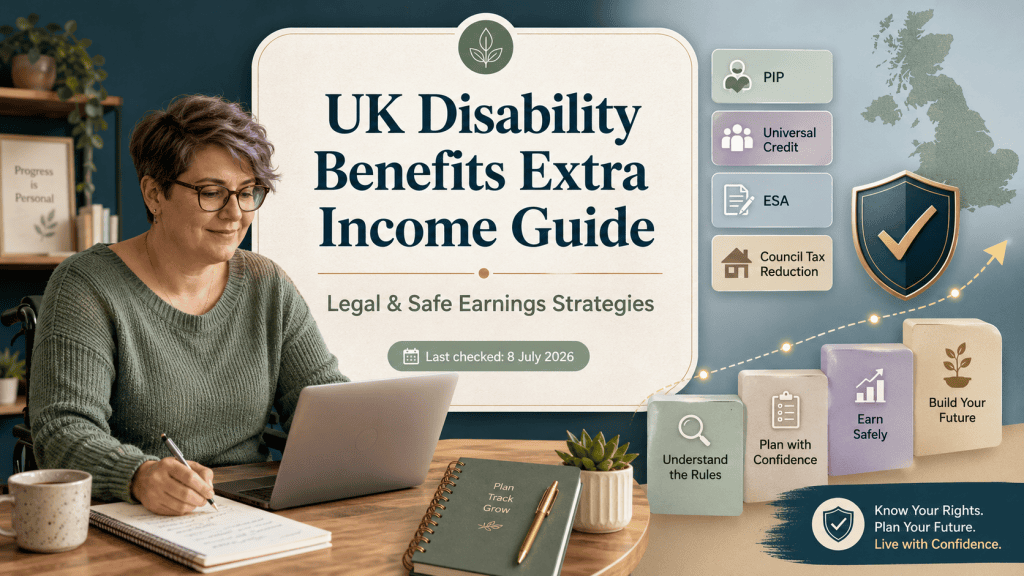
Here are the main rules at a glance.
PIP: Not directly affected by earnings. PIP is based on how your condition affects daily living and mobility, not how much you earn.
Universal Credit: Earnings can reduce UC through the taper. The reduction is usually 55p for every £1 earned above your work allowance.
UC work allowance with housing costs: £427 per month before UC starts to reduce, if you qualify for a work allowance.
UC work allowance without housing costs: £710 per month before UC starts to reduce, if you qualify for a work allowance.
ESA permitted work: Less than 16 hours per week and no more than £203.50 per week after tax and National Insurance.
UC capital rules: Below £6,000 normally has no effect. £6,000 to £16,000 reduces UC. Over £16,000 usually ends entitlement.
Rent-a-Room tax threshold: Up to £7,500 per year tax-free from letting furnished accommodation in your home. This is a tax rule, not a benefit rule.
These figures can change each April. Always check the current GOV.UK figures or speak to a welfare rights adviser before making a major income decision.
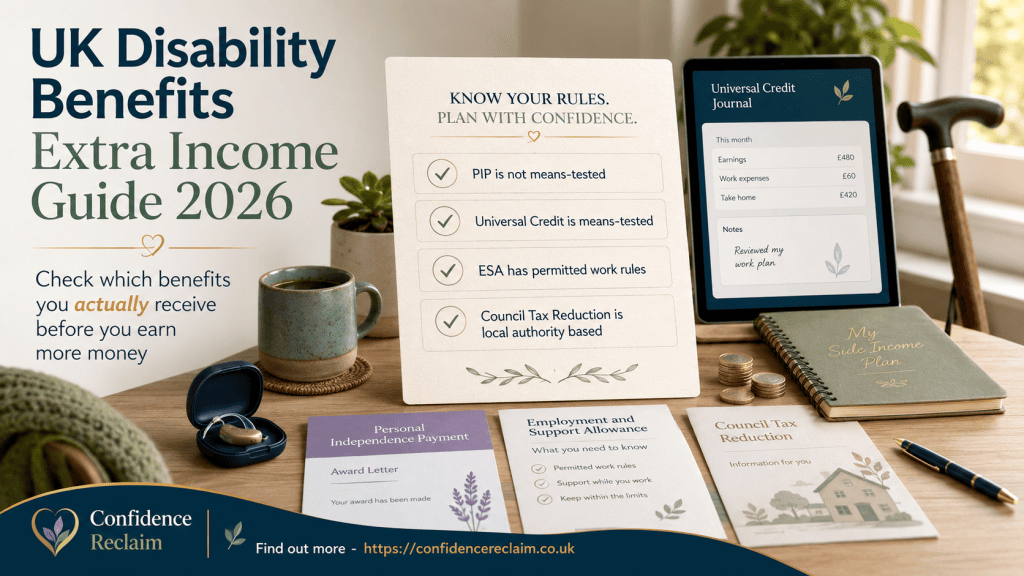
Before you earn more money, check your current benefits.
This matters because the rules are not the same.
PIP is not means-tested.
Universal Credit is means-tested.
ESA has permitted work rules.
Council Tax Reduction is set by your local authority.
Do not assume that one rule applies to every benefit. A person can work while receiving PIP, but that does not mean their Universal Credit will stay the same. A person on ESA may be allowed to do permitted work, but they still need to stay within the permitted work limits.
Check your award letters, your Universal Credit journal or your most recent DWP correspondence. If you are unsure, ask Citizens Advice, Turn2us, Scope or a local welfare rights adviser.
UK Disability Benefits Extra Income Guide
Personal Independence Payment, usually called PIP, is not based on your income, savings or employment status.
You can work part-time, work full-time, be self-employed or have savings and still receive PIP, as long as you meet the disability-related criteria.
Your PIP award is based on how your condition affects your ability to manage daily living activities and mobility tasks. It is not reduced because you earn wages.
There is one practical caution.
If your work activity appears to contradict the difficulties described in your PIP claim, it could be relevant if your award is reviewed. For example, if your claim says you have severe mobility difficulties, but your job involves regular physical activity, the DWP may ask whether your award still reflects your needs.
That does not mean you cannot work.
It means your work, your health evidence and your PIP claim should be consistent and honest.
Universal Credit is affected by earnings.
There is no fixed limit on the number of hours you can work while claiming Universal Credit. Instead, UC uses a monthly calculation.
For every £1 you earn from work, your Universal Credit usually goes down by 55p. This is known as the taper rate.
Some people get a work allowance. This means they can earn a set amount each month before the 55p taper starts.
You may get a work allowance if you or your partner are either:
If you qualify for a work allowance, the 2026/27 figures are:
If you do not qualify for a work allowance, your UC usually starts reducing from the first pound of earnings.
Example: UC work allowance with housing costs
Say your work allowance is £427 per month because your UC includes housing costs.
You earn £627 in one assessment period.
The first £427 is ignored.
The remaining £200 is affected by the 55p taper.
Your UC is reduced by £110.
You still keep £90 of the £200 earned above your allowance, plus the £427 that was ignored.
This is why earning more does not usually mean losing your whole UC award at once. It usually means your UC reduces gradually as your earnings rise.
How to report earnings on Universal Credit
If you are employed, your employer usually reports your wages to HMRC through Real Time Information. Those figures normally feed into your Universal Credit account.
Still, check your journal.
Mistakes can happen, especially if you are paid weekly, paid early because of a bank holiday, receive a bonus or change your hours.
If you are self-employed, you must report your income and allowable expenses through your Universal Credit account every monthly assessment period.
Keep simple records:
The risk is usually not earning. The risk is earning and not reporting it properly.
If you claim Employment and Support Allowance, including New Style ESA or older ESA claims, different rules apply.
For 2026/27, ESA permitted work generally means you can:
GOV.UK currently says there is no limit on the number of weeks you can do permitted work or supported permitted work, as long as the conditions are met.
Before you start work, you should complete the permitted work form PW1 and send it to the address shown on your ESA letters. If you cannot do this before starting, send it as soon as possible.
Do not rely on old 52-week permitted work wording without checking current guidance. This area has changed over time, and outdated advice can cause confusion.
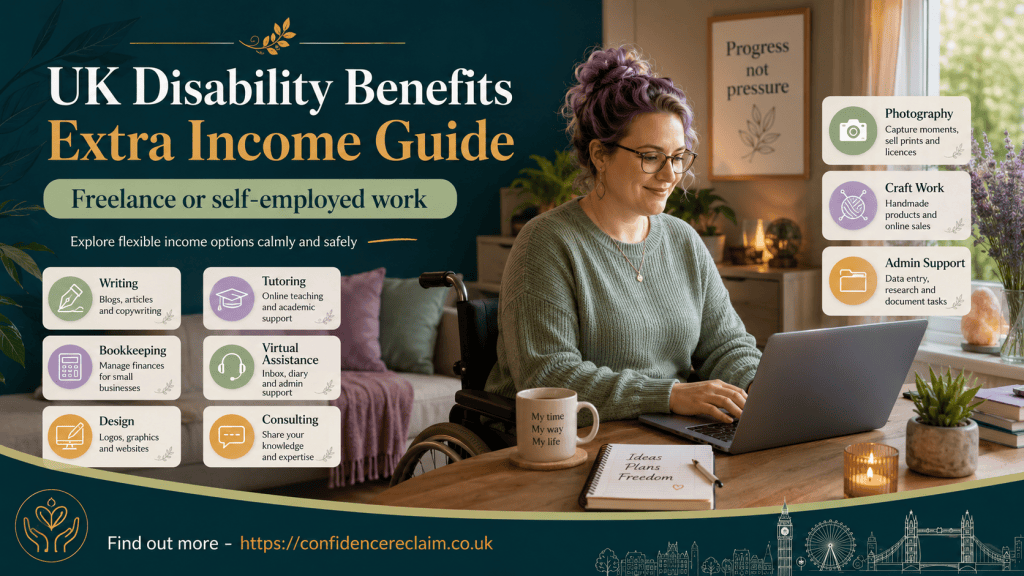
Freelance work can be a good fit for some disabled people because it may offer more control over hours, energy and workload.
Examples include:
UK Disability Benefits Extra Income Guide
Under Universal Credit, self-employed earnings are reported monthly. Your profit, not just your income, is what matters. That means you usually report what you received and deduct allowable business expenses.
The work allowance and 55p taper can still apply to self-employed earnings.
There is one extra rule to understand: the Minimum Income Floor.
If the DWP decides you are gainfully self-employed, and your start-up period has ended, it may treat you as earning a minimum amount even if your actual earnings are lower. The Minimum Income Floor does not normally apply if you are not expected to look for work, but this depends on your UC work group and circumstances.
Before relying on self-employment income, check your UC journal or ask a welfare rights adviser what work-related group you are in.
Selling your own unwanted items is usually different from running a business.
If you sell old clothes, furniture, books or electronics that you already owned, this is usually treated as selling personal possessions. It is not normally the same as trading income.
But if you buy items to resell, make goods to sell regularly or run an online shop, that may be treated as self-employment.
The HMRC trading allowance lets you earn up to £1,000 of trading income in a tax year before you need to pay tax on that trading income. But this is a tax rule. It is not a Universal Credit disregard.
If you are doing regular trading while claiming Universal Credit, you may still need to report it through your UC account even if the amount is below the HMRC tax threshold.
The safe rule is simple: occasional personal sales are usually different from business activity. If it looks like a business, treat it like one and get advice.
The Rent-a-Room Scheme allows you to earn up to £7,500 per year tax-free from letting furnished accommodation in your home. If you share the income with someone else, the threshold is usually £3,750 each.
For Universal Credit, rent from a non-family lodger in your home is generally not treated as income, so it should not reduce your UC.
But there are still things to check before taking in a lodger.
You may need permission from your landlord, mortgage provider or freeholder. You should also check your home insurance, Council Tax position and whether any HMO rules could apply.
If you currently receive the 25 percent single person Council Tax discount, taking in a lodger could remove that discount unless an exception applies.
If you rent from a council or housing association and have a spare room deduction, often called bedroom tax, getting a lodger may not remove that deduction under Universal Credit.
This is a good example of why you should check the whole picture, not just the income figure.
Savings and investments can affect Universal Credit through the capital rules.
The key thresholds are:
The tariff income rule means UC is reduced by £4.35 per month for every £250, or part of £250, between £6,000 and £16,000.
ISAs still count as capital for Universal Credit. Premium Bonds also count as capital.
The important point is not only the interest or prize money. It is the total amount of capital you hold.
PIP is different. Savings and capital do not reduce PIP.
Some payments from charities, friends or family may be disregarded for Universal Credit, especially where they are genuinely voluntary and not payment for work or services.
But be careful with regular arrangements.
If money is paid in return for work, services, rent, trading activity or business activity, it may be treated differently. Keep records and get advice if the payments are regular, large or unclear.
Council Tax Reduction is not the same everywhere.
Each local authority sets its own scheme, so the effect of earnings, savings, PIP and household changes can vary depending on where you live.
If your income changes, check your council’s rules directly. Do not assume that your UC treatment and Council Tax Reduction treatment will be identical.
UK Disability Benefits Extra Income Guide
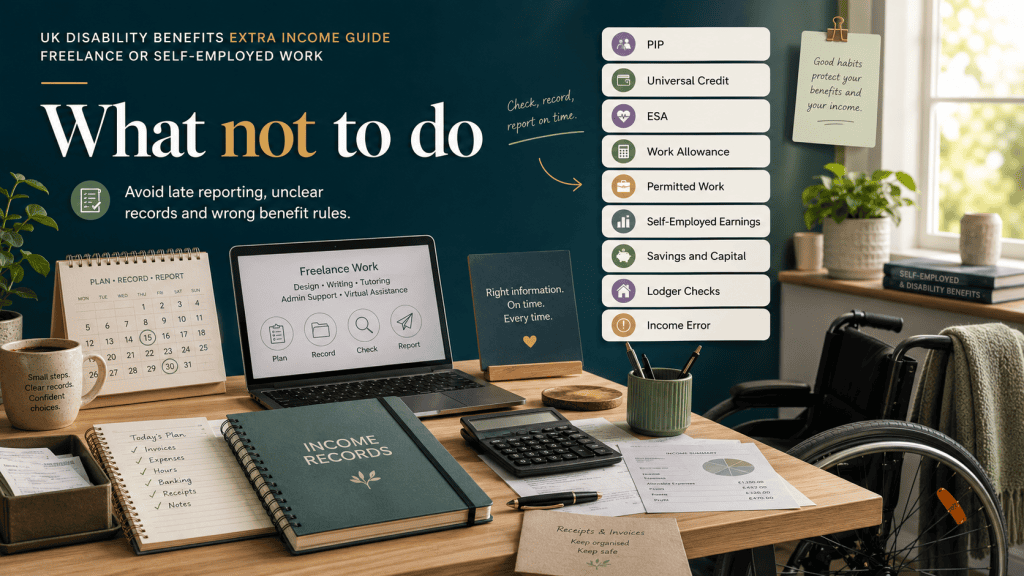
Avoid these common mistakes:
Most problems come from late reporting, unclear records or applying the wrong benefit rule.
UK Disability Benefits Extra Income Guide
Before you start, take these steps.
Useful places to start include Citizens Advice, Turn2us, Scope, Disability Rights UK and your local welfare rights service.
UK Disability Benefits Extra Income Guide
Can I work and still receive PIP?
Yes. PIP is not reduced because you work or earn money. Your award is based on how your condition affects daily living and mobility. The practical issue is whether your work activity is consistent with the difficulties described in your claim.
How much can I earn on Universal Credit in 2026?
There is no simple earnings limit for Universal Credit. If you qualify for a work allowance, you can earn £427 per month before UC reduces if you get housing support, or £710 per month if you do not. After that, UC usually reduces by 55p for every £1 earned.
If you do not qualify for a work allowance, the 55p taper usually applies from the first pound of earnings.
How much can I earn on ESA permitted work in 2026?
For 2026/27, the ESA permitted work limit is less than 16 hours per week and no more than £203.50 per week after tax and National Insurance.
You should complete form PW1 before starting work where possible.
Does selling on Vinted or eBay affect Universal Credit?
Occasional sales of your own personal possessions are usually different from running a business. But if you buy items to resell, make goods to sell or sell regularly as a trading activity, this may count as self-employment and may need to be reported.
Does a lodger affect Universal Credit?
If the lodger is not a family member, rent from a lodger in your home is generally not treated as income for Universal Credit. But it can still affect Council Tax, tenancy permissions, insurance and housing rules.
Do savings affect PIP?
No. Savings do not reduce PIP.
Do savings affect Universal Credit?
Yes, if your capital is over £6,000. Capital between £6,000 and £16,000 reduces UC. Capital over £16,000 usually means you cannot get UC.
UK Disability Benefits Extra Income Guide
You do not have to avoid earning money just because you claim disability benefits.
You do need to know which rules apply to you.
PIP, Universal Credit, ESA and Council Tax Reduction all work differently. Once you understand the difference, it becomes much easier to make safe, informed choices.
At Confidence Reclaim, we help people understand disability benefits, money worries and practical next steps with more confidence. Start with our guide to income planning for disability benefits in 2026 if you want a more detailed plan.
If you have ambition but currently feel held back or face a lack of opportunities, then ‘The Confidence Regain Graduated Income Plan’ may be your ideal next step.
Find more details here –
‘The UK – “Benefits-Safe” Income Method Politicians Can’t Touch’
Income Planning For Disability Benefits
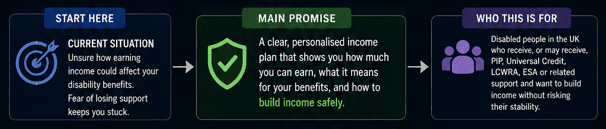
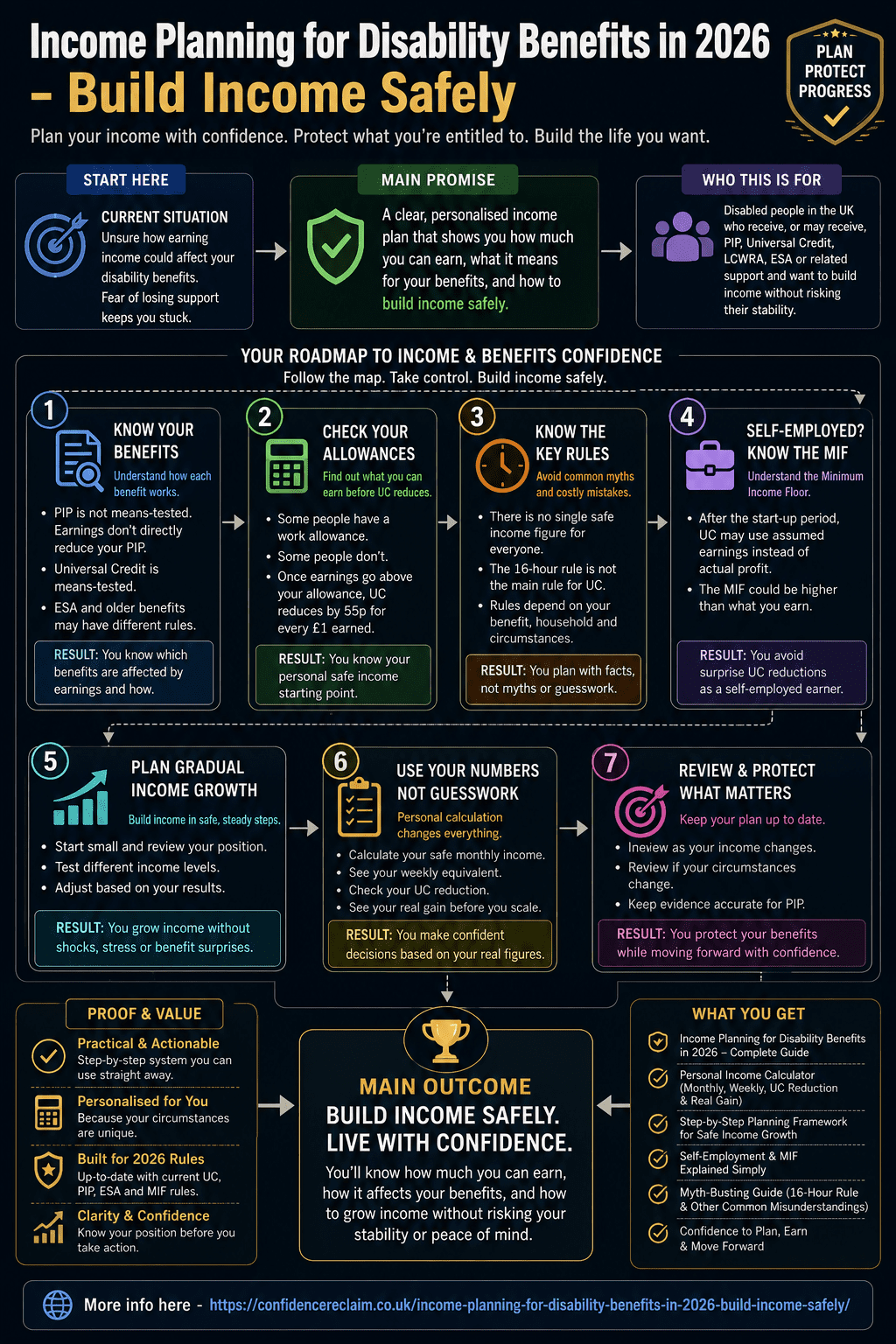
This guide is for disabled people in the UK who receive, or may receive, PIP, Universal Credit, LCWRA, ESA or related support and want to understand how earned income could affect their benefit position.
It is also for people who are thinking about part-time work, self-employment, increasing hours, changing rates or testing income after a period of illness or disability.
The aim is simple.
To help you plan income without guessing.
This guide covers
This guide covers Universal Credit, PIP, LCWRA, ESA transition, self-employment, the Minimum Income Floor and safe income planning.
It explains how earned income may affect your benefit position before you increase work, hours or self-employed income.
For your own figures, use the Confidence Reclaim Starter Pack calculator.
Planning income around UK disability benefits is not about avoiding work.
It is about avoiding guesswork.
For many disabled people, the hardest part is not motivation.
It is not ambition.
It is not the desire to move forward.
The hardest part is knowing where the line is.
Earn too little and nothing really changes.
Earn more without checking and it can feel like everything is at risk.
That uncertainty keeps people stuck. It is part of the benefits trap.
The benefit system in 2026 is more personal than it used to be.
Your safe income position depends on your actual circumstances, not one general figure copied from an article, calculator or advice forum.
That is why income planning now needs to start with your own numbers.
The Confidence Reclaim Starter Pack is built around that idea.
It helps you map your income gradually, test different earning levels and understand how your Universal Credit may change before you take bigger steps.
Income Planning For Disability Benefits
One of the biggest mistakes people make is treating all disability benefits as if they follow the same rules.
They do not.
Personal Independence Payment, Universal Credit, ESA, Carer’s Allowance and other linked support all work differently.
Some are affected by earnings.
Some are not directly affected by earnings.
Some may be affected by changes in your health, care needs, household or work pattern.
That difference matters.
A safe income plan starts by knowing which benefit you receive and how that benefit reacts when your income changes. Avoid the benefits trap.
PIP stands for Personal Independence Payment.
It is not means-tested.
That means your earnings do not directly reduce your PIP award.
You can earn income through employment or self-employment without your PIP being reduced simply because you earned money.
But PIP is still based on how your condition affects your daily living and mobility.
That means work can create an indirect risk if it appears inconsistent with the needs described in your PIP award.
For example, if your award is based on difficulty preparing food, managing journeys or moving around, and your work appears to contradict that evidence, it could raise questions at review.
That does not mean work is forbidden.
It means your evidence needs to stay accurate.
If your needs have not changed, keep records that show that.
If your needs have changed, get advice before you make decisions that rely on your current award staying the same.
Universal Credit is means-tested.
That means earnings can affect how much you receive.
If you have a work allowance, you may be able to earn up to that allowance before your UC reduces.
If you do not have a work allowance, your UC may reduce as soon as your earnings are counted.
Once the taper applies, Universal Credit usually reduces by 55p for every £1 of earnings above your relevant allowance.
That is not a cliff edge.
It is a gradual reduction.
But it still changes your monthly position.
This is why your own calculator matters.
You need to know whether you have a work allowance, where that allowance sits and what happens if you earn above it.
Many people are moving from older benefits to Universal Credit.
But not everyone has moved yet.
If you are still on Employment and Support Allowance, the rules may be different.
Hours rules, permitted work rules and earnings limits may still apply.
Do not assume UC rules apply to you until you know what benefit you are actually on.
If you are still on ESA or transitioning, check with a benefits adviser before starting work, increasing hours or becoming self-employed.
Many people still believe they must stay under 16 hours a week.
For Universal Credit, that is not the main rule.
UC is based mainly on income and household circumstances, not a fixed 16-hour limit.
What matters is how much you earn and how those earnings affect your UC calculation.
This is a major shift.
The old question was:
“How many hours can I work?”
The better question is:
“What level of income is safe for me?”
There is one important warning.
If you are still on ESA or another older benefit, hours rules may still matter.
So the safest wording is this:
For Universal Credit, focus on income.
For ESA or older benefits, check the hours rules before making changes.
Work, PIP and reviews: what “Right to Try” does and does not protect
From 30 April 2026, paid work or voluntary work should not, by itself, be treated as a reason to trigger a PIP award review or a Work Capability Assessment reassessment.
This is sometimes described as a “Right to Try” work protection.
But it is not a guarantee that work can never lead to questions about your award.
The DWP can still look at the type of work you are doing. If the work appears to suggest that your functional ability has changed, or that your previous award may no longer reflect your needs, it may still lead to a PIP review or WCA reassessment.
For example, work that appears inconsistent with the difficulties described in your PIP award, LCW or LCWRA decision may create risk. Work that is clearly adapted around your condition, supported by adjustments or consistent with your limitations may carry less risk.
This does not mean disabled people should avoid work. It means work should be planned carefully. Keep records of your limits, adjustments, support, reduced hours, rest periods and any help you need to do the work safely.
If your condition or daily living needs have changed, get advice before relying on your existing award.
Work alone should not trigger a review, but work that appears inconsistent with your award may still raise questions.
If your needs have not changed, make sure your records explain how the work is possible despite your condition.
The word in a few conversations recently, where people are talking quietly about the DWP’s “Right To Try” situation.
Not panic talk.
More like the kind of careful, experienced advice you hear from people who’ve seen how these things play out in real life.
And honestly, out of the 5 things I keep hearing, from people who know how to move intelligently, this is probably the best piece of advice.
Get advice before you report, not after things go wrong.
This is the biggest one.
The people who handle this best do not wait until a review letter lands.
They speak to a welfare rights adviser, benefits specialist or trusted support organisation before making big moves.
Not because they are doing anything wrong.
Because they understand that wording matters, timing matters and evidence matters.
The honest truth is this:
Trying work should be safe.
People should not be punished for testing their capacity.
But until the system actually protects people properly, the safest move is not fear.
It is preparation.
LCWRA 2026
From 6 April 2026, LCWRA has two monthly rates.
The lower LCWRA amount is £217.26 per month.
The higher LCWRA amount is £429.80 per month.
You may get the higher amount if you reported your health condition before 6 April 2026, were already getting LCWRA before that date, meet the severe lifelong condition criteria or are nearing the end of life.
If you are part of a couple and both partners qualify for LCWRA, only one LCWRA amount is paid, and the higher amount applies if one partner qualifies for it.
There is no single safe income figure that applies to everyone.
Your position depends on your household, housing support, children, health status, work allowance, UC taper, self-employment rules and any deductions.
Two people can both receive Universal Credit and PIP, but have completely different safe income levels.
One person may receive housing support.
Another may not.
One person may have children.
Another may have LCWRA.
One person may be employed.
Another may be self-employed and close to the Minimum Income Floor.
The Confidence Reclaim Starter Pack calculator helps you check your own position before increasing income.
That is safer than relying on a generic number.
From 6 April 2026, the Universal Credit two-child limit ended.
Universal Credit can now include a child amount for every child you are responsible for, not just the first two.
This can change the safe income calculation for larger families, but the benefit cap and other deductions may still affect the final amount paid.
Important for larger households:
Even where extra child amounts apply, the benefit cap may still limit the total amount paid.
If you have several children, housing support or a high UC entitlement, check whether the benefit cap affects your final award.
Universal Credit tapering is gradual.
But the experience can still feel steep.
If your earnings rise above your work allowance, your UC reduces as your earnings increase.
You may still be better off overall, but the extra income may not feel as large as expected.
This is why the phrase “benefits trap” resonates with so many people.
You earn more.
Then UC adjusts.
You keep some of the extra money, but not all of it.
The answer is not to avoid earning.
The answer is to plan the increase.
A sudden jump can create pressure if you have not checked your assessment period, housing support, deductions, tax position, self-employment rules or LCWRA status.
A gradual increase gives you time to see what happens.
It lets you test your numbers before you rely on the income.
Your safe income can change depending on:
This is why quoting one fixed number can be misleading.
One person may have a work allowance.
Another may not.
One person may receive housing support.
Another may not.
One person may have LCWRA protection.
Another may be in a waiting period.
One answer cannot safely cover all of those situations.
The safer approach is to calculate your own position.
A proper income plan does not just ask:
“How much do I get now?”
It asks:
“What happens if I earn this amount?”
That is a different question.
You need to know:
This is where a personal planner becomes useful.
It turns a vague fear into a number you can work with.
Generic benefit calculators can give a useful starting point.
But they cannot always show the emotional and practical journey of building income safely.
The Confidence Reclaim Starter Pack calculator is designed for people who need more than a snapshot.
It helps you test your income before you act.
It shows your safe monthly income.
It converts that into a weekly equivalent.
It estimates how much UC may reduce.
It shows the real gain from extra earnings before tax and NI.
That matters because Universal Credit is assessed monthly, but many people think weekly.
The calculator helps bridge that gap.
It keeps the planning simple without pretending the rules are simple.
Income Planning For Disability Benefits
A fixed figure can feel reassuring.
But it can also be wrong for your situation.
Some people have a work allowance because they have children or limited capability for work.
Some people do not.
Some people receive housing support.
Some people do not.
Some people have deductions that change their final award.
Some people are self-employed and may need to consider the Minimum Income Floor.
So the safest public guidance is:
Use your own numbers.
Check your own UC position.
Treat the calculator as a planning guide, not a legal decision.
If you are unsure, speak to your UC adviser or a benefits adviser before making a major change.
The safest way to build income is gradually.
That does not mean staying small.
It means growing with checkpoints.
Step 1: Know your current benefit position
Before changing income, check what you currently receive.
Look at your UC statement.
Check whether you have a work allowance.
Check whether you receive housing support.
Check whether you have LCWRA, LCW, child elements, carer elements or deductions.
If you receive PIP, check your award letter and review date.
Do not build a plan around memory.
Build it around documents.
Step 2: Use the calculator before increasing income
Before increasing hours, rates or self-employed work, enter your details into the CRSP calculator.
Check:
This gives you a clearer starting point.
You are not guessing.
You are checking.
Step 3: Start with a small test
A first step does not need to be dramatic.
Small income can still build confidence.
A small test helps you see how earnings feel, how reporting works and how UC responds.
The goal is not to rush.
The goal is to build proof.
Step 4: Track your UC assessment period
Universal Credit is calculated monthly.
The date you are paid can affect which assessment period the income lands in.
This matters if you are paid early, paid late, paid twice in one month or receive a one-off payment.
Keep records.
Check statements.
Report changes promptly.
Step 5: Build a buffer before scaling
A financial buffer gives you room to absorb delays, reassessments or unexpected payment changes.
A three-month buffer is a strong protection before scaling income further.
If that feels impossible, start smaller.
Even a small buffer is better than no buffer.
The point is to reduce panic.
Most benefit problems are not caused by earning itself.
They are caused by poor timing, missing reports, misunderstood rules or relying on the wrong number.
These are the mistakes to avoid.
Universal Credit is assessed monthly.
If your income changes, that change can affect your award.
Do not assume the system will always pick everything up correctly.
If you start work, increase hours, take on a contract, receive a one-off payment or change your self-employed income, keep records and report what you need to report.
Late reporting can lead to overpayments.
Overpayments can reduce future UC payments.
That can create the exact instability you were trying to avoid.
The safer rule is simple.
Report changes promptly.
Keep proof.
Check your next UC statement.
Self-employment is not treated the same as employed work.
If you are employed through PAYE, earnings are usually reported through HMRC’s real-time system.
If you are self-employed and claiming Universal Credit, you normally need to report your income and allowable business expenses each month through your UC journal.
This is where many people get caught out.
After the self-employment start-up period, the Minimum Income Floor may apply.
That means Universal Credit may treat you as earning an assumed level of income, even in a month where your actual profit is lower.
This can reduce your UC more than expected.
You may be eligible for a 12-month start-up period if you are self-employed.
During that period, your monthly earnings are normally used to work out your UC and the Minimum Income Floor does not apply.
Your work coach can confirm whether you qualify for a start-up period.
That first year can feel manageable because UC is looking at your reported self-employed profit.
But once the Minimum Income Floor applies, the calculation may change.
This does not mean self-employment is unsafe.
It means self-employment needs planning.
Before relying on self-employed income, check:
The CRSP calculator can help you understand UC taper and safe income planning.
But self-employed claimants should also check the MIF position with their UC adviser or a benefits adviser before scaling.
PIP is not means-tested.
That does not mean it is permanent.
Your PIP award is based on assessed needs.
If your condition improves, your needs change or your work activity appears inconsistent with your award, DWP may ask questions at review.
The safest approach is not to avoid working.
It is to keep your evidence accurate.
Keep medical records.
Keep notes of support needs.
Keep evidence of adjustments.
Keep a copy of your award letter.
If you are unsure whether a work plan could affect how your needs are understood, get advice before relying on that income.
Not everyone has a UC work allowance.
This is an important point.
A work allowance usually applies if you have children or limited capability for work.
If you do not have a work allowance, your UC may reduce as soon as earnings are counted.
This is why fixed income advice can be risky.
If an article says “you can earn up to this amount safely,” but you do not qualify for that allowance, the advice may not apply to you.
Use your own calculator result.
Even if the numbers look right, timing can still create pressure.
Payments can be delayed.
Reviews can take time.
Assessment periods can produce unexpected results.
Self-employed income can fluctuate.
A buffer gives you room to breathe.
The goal is not to build income at any cost.
The goal is to build income without creating a crisis.
Leaving benefits entirely is a major step.
The right time is not simply when your income first looks promising.
It is when your income is stable enough, consistent enough and high enough to replace the support you may lose.
That calculation is personal.
A clean transition should happen from strength, not pressure.
If you are building income gradually, your goal is not to escape benefits overnight.
Your goal is to become less dependent on them safely.
Transition readiness checklist
Before making a major income jump or moving away from benefit support, check the following:
✓ Your earned income has been stable for several months
✓ Your monthly income comfortably covers essential costs
✓ You have checked your UC taper position
✓ You understand whether you have a work allowance
✓ You have checked whether the Minimum Income Floor applies
✓ You have reviewed any linked benefits
✓ You have checked your PIP award conditions and review date
✓ You have built a financial buffer
✓ You have confirmed your reporting duties
✓ You have spoken to a benefits adviser if your situation is complex
This checklist is not there to slow you down.
It is there to stop one mistake undoing your progress.
Check your own safe income before you scale
Generic figures can be misleading.
Your safe income depends on your housing support, household, children, health status, work allowance and UC position.
The Confidence Reclaim Starter Pack calculator helps you check your own monthly safe income, weekly equivalent, UC reduction and real gain before you increase work or self-employed income.
Use it before you scale.
Earning income does not directly reduce PIP because PIP is not means-tested.
You can earn income through employment or self-employment and your PIP is not reduced simply because you earned money.
But PIP can still be affected indirectly if your work appears inconsistent with the needs described in your award.
If your condition, care needs or daily living ability changes, that may affect your award at review.
The Universal Credit work allowance is the amount some claimants can earn before UC starts to reduce.
Not everyone has a work allowance.
It usually applies where someone has children or limited capability for work.
If you do not have a work allowance, your UC may reduce as soon as earnings are counted.
This is why your personal calculator result matters more than a general figure.
Universal Credit does not use the old 16-hour rule in the same way.
UC is based mainly on income and household circumstances.
What matters is how much you earn and how those earnings affect your UC calculation.
If you are still on ESA or transitioning from older benefits, hours rules may still apply.
Check before making changes.
If you earn above your relevant work allowance, UC usually reduces through the taper.
The usual taper is 55p for every £1 above the allowance.
That means you still keep some of the extra earnings, but your UC may reduce.
The calculator helps show what that looks like in your own situation.
Yes, but self-employment has extra rules.
If you are self-employed and claiming UC, you normally need to report income and allowable expenses each month through your UC journal.
After the start-up period, the Minimum Income Floor may apply.
This means UC may treat you as earning an assumed amount, even if your actual profit is lower that month.
That can change your safe income planning.
Use the CRSP calculator to understand taper impact, but get specific advice on self-employment rules before scaling.
The Minimum Income Floor usually does not apply during the self-employment start-up period.
That start-up period is commonly 12 months.
After that, UC may assume you earn a certain level from self-employment.
This can reduce UC more than expected in a low-profit month.
If you are approaching the end of your start-up period, check your position before making income plans.
If you have LCWRA and earnings reduce your UC to zero, there may be protections that allow you to return within a limited period without a fresh Work Capability Assessment.
The details depend on your situation and timing.
Do not rely on this without checking your own claim.
If you are on ESA rather than UC, the rules are different.
Get advice before starting work if returning safely is a major concern.
Yes, if possible.
A buffer protects you if payments are delayed, UC changes more than expected or a review takes time.
Three months of essential costs is a strong target.
If that feels too much, start smaller.
The important thing is to build some protection before relying on higher income.
No.
The calculator is a planning tool.
It helps estimate UC taper impact, safe income and real gain.
It does not calculate every exception, tax, NI, surplus earnings, sanctions, capital rules, self-employment complexity or every deduction.
Use it to plan more safely.
If you are unsure, check with your UC adviser or a qualified benefits adviser
Building income while receiving disability benefits can feel frightening.
But fear usually grows in the gap between not knowing and needing to act.
The safest path is to close that gap.
Check your award.
Use your calculator.
Test small steps.
Report changes.
Keep records.
Build a buffer.
Get advice where the rules are complex.
You do not need one general answer.
You need your answer.
That is what the Confidence Reclaim Starter Pack calculator is designed to help you find.
Last reviewed: May 2026.
Benefit rules change.
Check current GOV.UK guidance or speak to a qualified benefits adviser before making major income decisions.
Income Planning For Disability Benefits