Income Planning for Disability Benefits in 2026: Build Income Safely
Article at a glance
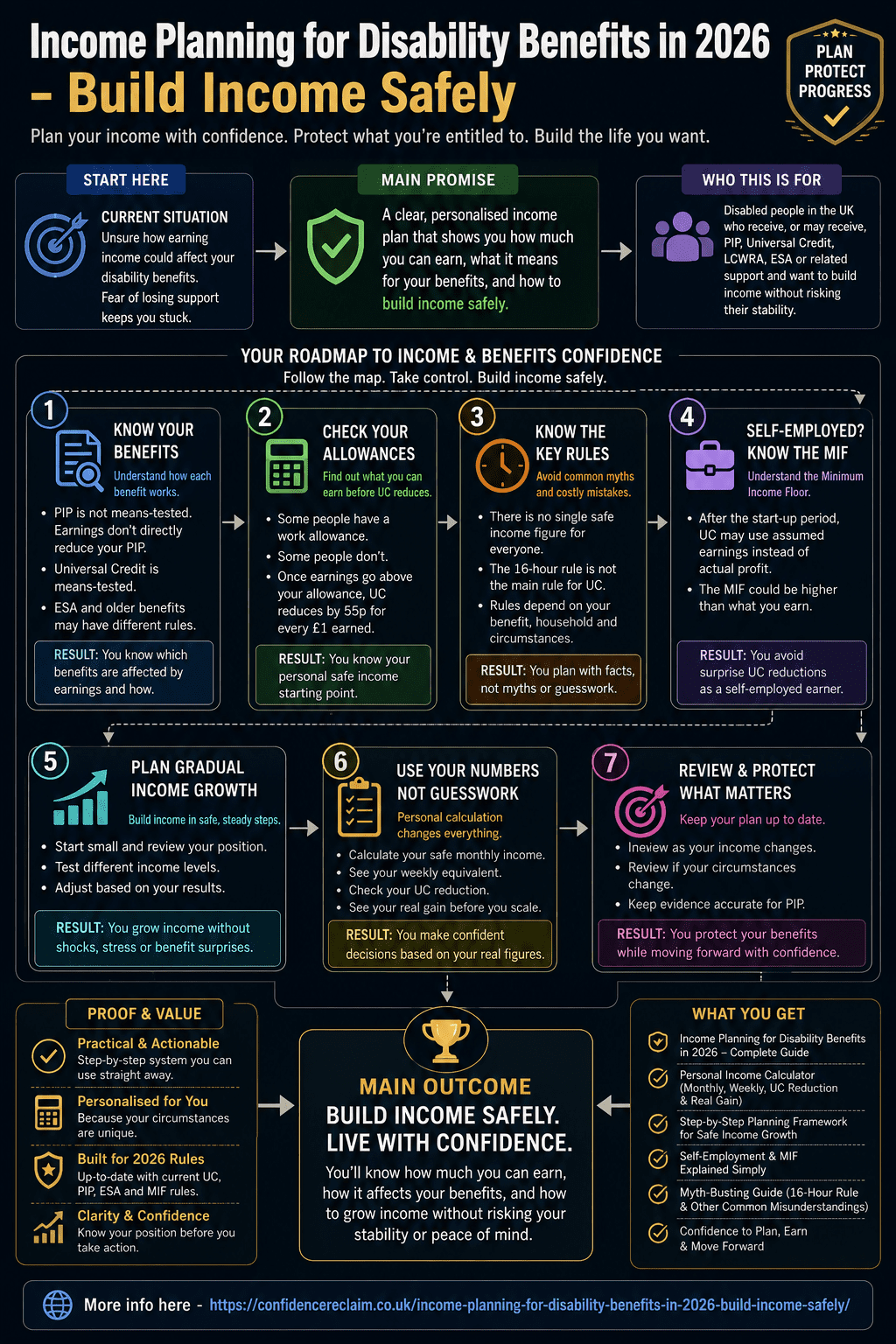
- PIP is not means-tested, which means earned income does not directly reduce your PIP award.
- Universal Credit works differently. Earnings can reduce UC through the taper system once income is counted above any relevant work allowance.
- There is no single safe income figure that applies to everyone. Your safe level depends on your household, housing support, children, health status and UC position.
- Some people have a work allowance. Some people do not. This is why personal calculation matters.
- The old “16-hour rule” is not the main rule for Universal Credit, but it may still matter if you are on ESA or transitioning from older benefits.
- Self-employed claimants need to understand the Minimum Income Floor. After the start-up period, UC may be calculated using assumed earnings rather than actual profit.
- A gradual income plan is the safest way to build income while protecting stability.
- The Confidence Reclaim Starter Pack calculator helps you check your own safe monthly income, weekly equivalent, UC reduction and real gain before you scale.
Income Planning For Disability Benefits
Who this guide is for
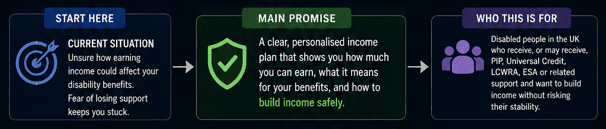
This guide is for disabled people in the UK who receive, or may receive, PIP, Universal Credit, LCWRA, ESA or related support and want to understand how earned income could affect their benefit position.
It is also for people who are thinking about part-time work, self-employment, increasing hours, changing rates or testing income after a period of illness or disability.
The aim is simple.
To help you plan income without guessing.
This guide covers
This guide covers Universal Credit, PIP, LCWRA, ESA transition, self-employment, the Minimum Income Floor and safe income planning.
It explains how earned income may affect your benefit position before you increase work, hours or self-employed income.
For your own figures, use the Confidence Reclaim Starter Pack calculator.
Planning income around disability benefits in 2026
Planning income around UK disability benefits is not about avoiding work.
It is about avoiding guesswork.
For many disabled people, the hardest part is not motivation.
It is not ambition.
It is not the desire to move forward.
The hardest part is knowing where the line is.
Earn too little and nothing really changes.
Earn more without checking and it can feel like everything is at risk.
That uncertainty keeps people stuck. It is part of the benefits trap.
The benefit system in 2026 is more personal than it used to be.
Your safe income position depends on your actual circumstances, not one general figure copied from an article, calculator or advice forum.
That is why income planning now needs to start with your own numbers.
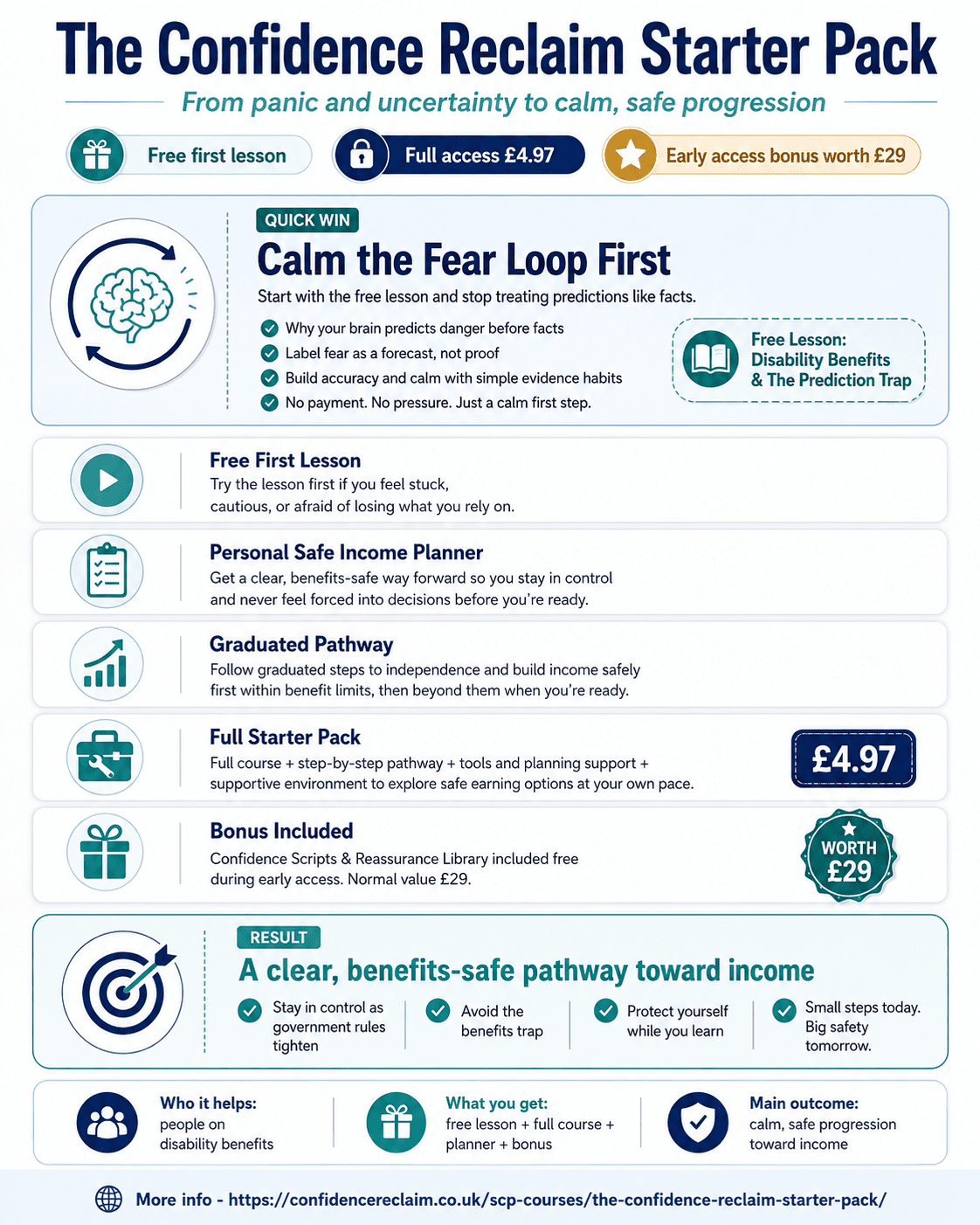
The Confidence Reclaim Starter Pack is built around that idea.
It helps you map your income gradually, test different earning levels and understand how your Universal Credit may change before you take bigger steps.
Income Planning For Disability Benefits
Your benefits are not one single block
One of the biggest mistakes people make is treating all disability benefits as if they follow the same rules.
They do not.
Personal Independence Payment, Universal Credit, ESA, Carer’s Allowance and other linked support all work differently.
Some are affected by earnings.
Some are not directly affected by earnings.
Some may be affected by changes in your health, care needs, household or work pattern.
That difference matters.
A safe income plan starts by knowing which benefit you receive and how that benefit reacts when your income changes. Avoid the benefits trap.
How PIP, Universal Credit and ESA react differently to earned income
PIP
PIP stands for Personal Independence Payment.
It is not means-tested.
That means your earnings do not directly reduce your PIP award.
You can earn income through employment or self-employment without your PIP being reduced simply because you earned money.
But PIP is still based on how your condition affects your daily living and mobility.
That means work can create an indirect risk if it appears inconsistent with the needs described in your PIP award.
For example, if your award is based on difficulty preparing food, managing journeys or moving around, and your work appears to contradict that evidence, it could raise questions at review.
That does not mean work is forbidden.
It means your evidence needs to stay accurate.
If your needs have not changed, keep records that show that.
If your needs have changed, get advice before you make decisions that rely on your current award staying the same.
Universal Credit
Universal Credit is means-tested.
That means earnings can affect how much you receive.
If you have a work allowance, you may be able to earn up to that allowance before your UC reduces.
If you do not have a work allowance, your UC may reduce as soon as your earnings are counted.
Once the taper applies, Universal Credit usually reduces by 55p for every £1 of earnings above your relevant allowance.
That is not a cliff edge.
It is a gradual reduction.
But it still changes your monthly position.
This is why your own calculator matters.
You need to know whether you have a work allowance, where that allowance sits and what happens if you earn above it.
ESA and older benefits
Many people are moving from older benefits to Universal Credit.
But not everyone has moved yet.
If you are still on Employment and Support Allowance, the rules may be different.
Hours rules, permitted work rules and earnings limits may still apply.
Do not assume UC rules apply to you until you know what benefit you are actually on.
If you are still on ESA or transitioning, check with a benefits adviser before starting work, increasing hours or becoming self-employed.
The 16-hour rule: myth and reality
Many people still believe they must stay under 16 hours a week.
For Universal Credit, that is not the main rule.
UC is based mainly on income and household circumstances, not a fixed 16-hour limit.
What matters is how much you earn and how those earnings affect your UC calculation.
This is a major shift.
The old question was:
“How many hours can I work?”
The better question is:
“What level of income is safe for me?”
There is one important warning.
If you are still on ESA or another older benefit, hours rules may still matter.
So the safest wording is this:
For Universal Credit, focus on income.
For ESA or older benefits, check the hours rules before making changes.
Work, PIP and reviews: what “Right to Try” does and does not protect
From 30 April 2026, paid work or voluntary work should not, by itself, be treated as a reason to trigger a PIP award review or a Work Capability Assessment reassessment.
This is sometimes described as a “Right to Try” work protection.
But it is not a guarantee that work can never lead to questions about your award.
The DWP can still look at the type of work you are doing. If the work appears to suggest that your functional ability has changed, or that your previous award may no longer reflect your needs, it may still lead to a PIP review or WCA reassessment.
For example, work that appears inconsistent with the difficulties described in your PIP award, LCW or LCWRA decision may create risk. Work that is clearly adapted around your condition, supported by adjustments or consistent with your limitations may carry less risk.
This does not mean disabled people should avoid work. It means work should be planned carefully. Keep records of your limits, adjustments, support, reduced hours, rest periods and any help you need to do the work safely.
If your condition or daily living needs have changed, get advice before relying on your existing award.
Work alone should not trigger a review, but work that appears inconsistent with your award may still raise questions.
If your needs have not changed, make sure your records explain how the work is possible despite your condition.
Can You Trust This Advice?
The word in a few conversations recently, where people are talking quietly about the DWP’s “Right To Try” situation.
Not panic talk.
More like the kind of careful, experienced advice you hear from people who’ve seen how these things play out in real life.
And honestly, out of the 5 things I keep hearing, from people who know how to move intelligently, this is probably the best piece of advice.
Get advice before you report, not after things go wrong.
This is the biggest one.
The people who handle this best do not wait until a review letter lands.
They speak to a welfare rights adviser, benefits specialist or trusted support organisation before making big moves.
Not because they are doing anything wrong.
Because they understand that wording matters, timing matters and evidence matters.
The honest truth is this:
Trying work should be safe.
People should not be punished for testing their capacity.
But until the system actually protects people properly, the safest move is not fear.
It is preparation.
LCWRA 2026
From 6 April 2026, LCWRA has two monthly rates.
The lower LCWRA amount is £217.26 per month.
The higher LCWRA amount is £429.80 per month.
You may get the higher amount if you reported your health condition before 6 April 2026, were already getting LCWRA before that date, meet the severe lifelong condition criteria or are nearing the end of life.
If you are part of a couple and both partners qualify for LCWRA, only one LCWRA amount is paid, and the higher amount applies if one partner qualifies for it.
Why personal calculation matters
There is no single safe income figure that applies to everyone.
Your position depends on your household, housing support, children, health status, work allowance, UC taper, self-employment rules and any deductions.
Two people can both receive Universal Credit and PIP, but have completely different safe income levels.
One person may receive housing support.
Another may not.
One person may have children.
Another may have LCWRA.
One person may be employed.
Another may be self-employed and close to the Minimum Income Floor.
The Confidence Reclaim Starter Pack calculator helps you check your own position before increasing income.
That is safer than relying on a generic number.
The 2 Child Limit
From 6 April 2026, the Universal Credit two-child limit ended.
Universal Credit can now include a child amount for every child you are responsible for, not just the first two.
This can change the safe income calculation for larger families, but the benefit cap and other deductions may still affect the final amount paid.
Important for larger households:
Even where extra child amounts apply, the benefit cap may still limit the total amount paid.
If you have several children, housing support or a high UC entitlement, check whether the benefit cap affects your final award.
The cliff edge problem: why sudden income jumps still feel risky
Universal Credit tapering is gradual.
But the experience can still feel steep.
If your earnings rise above your work allowance, your UC reduces as your earnings increase.
You may still be better off overall, but the extra income may not feel as large as expected.
This is why the phrase “benefits trap” resonates with so many people.
You earn more.
Then UC adjusts.
You keep some of the extra money, but not all of it.
The answer is not to avoid earning.
The answer is to plan the increase.
A sudden jump can create pressure if you have not checked your assessment period, housing support, deductions, tax position, self-employment rules or LCWRA status.
A gradual increase gives you time to see what happens.
It lets you test your numbers before you rely on the income.
Your safe income is personal
Your safe income can change depending on:
- Whether you are single or in a couple
• Your age category
• Whether you receive housing support
• Whether you have children
• Whether you have limited capability for work
• Whether you have LCWRA
• Whether you are a new or existing claimant
• Whether you have deductions
• Whether you are employed or self-employed
• Whether other benefits are linked to your award
This is why quoting one fixed number can be misleading.
One person may have a work allowance.
Another may not.
One person may receive housing support.
Another may not.
One person may have LCWRA protection.
Another may be in a waiting period.
One answer cannot safely cover all of those situations.
The safer approach is to calculate your own position.
UK income planner: mapping your benefits against earnings bands
A proper income plan does not just ask:
“How much do I get now?”
It asks:
“What happens if I earn this amount?”
That is a different question.
You need to know:
- Your current monthly UC position
• Whether you have a work allowance
• When the taper starts
• How much UC may reduce
• What you keep from extra earnings
• What your weekly income looks like
• Whether self-employment rules change the answer
• Whether you need advice before scaling
This is where a personal planner becomes useful.
It turns a vague fear into a number you can work with.
Get your own personal calculator: use the Confidence Reclaim Starter Pack
Generic benefit calculators can give a useful starting point.
But they cannot always show the emotional and practical journey of building income safely.
The Confidence Reclaim Starter Pack calculator is designed for people who need more than a snapshot.
It helps you test your income before you act.
It shows your safe monthly income.
It converts that into a weekly equivalent.
It estimates how much UC may reduce.
It shows the real gain from extra earnings before tax and NI.
That matters because Universal Credit is assessed monthly, but many people think weekly.
The calculator helps bridge that gap.
It keeps the planning simple without pretending the rules are simple.
Income Planning For Disability Benefits
Why the calculator does not quote one safe amount for everyone
A fixed figure can feel reassuring.
But it can also be wrong for your situation.
Some people have a work allowance because they have children or limited capability for work.
Some people do not.
Some people receive housing support.
Some people do not.
Some people have deductions that change their final award.
Some people are self-employed and may need to consider the Minimum Income Floor.
So the safest public guidance is:
Use your own numbers.
Check your own UC position.
Treat the calculator as a planning guide, not a legal decision.
If you are unsure, speak to your UC adviser or a benefits adviser before making a major change.
The safe gradual income strategy for disability benefit recipients
The safest way to build income is gradually.
That does not mean staying small.
It means growing with checkpoints.
Step 1: Know your current benefit position
Before changing income, check what you currently receive.
Look at your UC statement.
Check whether you have a work allowance.
Check whether you receive housing support.
Check whether you have LCWRA, LCW, child elements, carer elements or deductions.
If you receive PIP, check your award letter and review date.
Do not build a plan around memory.
Build it around documents.
Step 2: Use the calculator before increasing income
Before increasing hours, rates or self-employed work, enter your details into the CRSP calculator.
Check:
- Safe monthly income
• Weekly equivalent
• UC reduction
• Real gain
• Caution point
This gives you a clearer starting point.
You are not guessing.
You are checking.
Step 3: Start with a small test
A first step does not need to be dramatic.
Small income can still build confidence.
A small test helps you see how earnings feel, how reporting works and how UC responds.
The goal is not to rush.
The goal is to build proof.
Step 4: Track your UC assessment period
Universal Credit is calculated monthly.
The date you are paid can affect which assessment period the income lands in.
This matters if you are paid early, paid late, paid twice in one month or receive a one-off payment.
Keep records.
Check statements.
Report changes promptly.
Step 5: Build a buffer before scaling
A financial buffer gives you room to absorb delays, reassessments or unexpected payment changes.
A three-month buffer is a strong protection before scaling income further.
If that feels impossible, start smaller.
Even a small buffer is better than no buffer.
The point is to reduce panic.
Common mistakes that put disability benefits at risk
Most benefit problems are not caused by earning itself.
They are caused by poor timing, missing reports, misunderstood rules or relying on the wrong number.
These are the mistakes to avoid.
- Not reporting earnings changes to DWP on time
Universal Credit is assessed monthly.
If your income changes, that change can affect your award.
Do not assume the system will always pick everything up correctly.
If you start work, increase hours, take on a contract, receive a one-off payment or change your self-employed income, keep records and report what you need to report.
Late reporting can lead to overpayments.
Overpayments can reduce future UC payments.
That can create the exact instability you were trying to avoid.
The safer rule is simple.
Report changes promptly.
Keep proof.
Check your next UC statement.
- Confusing self-employment income rules with PAYE rules
Self-employment is not treated the same as employed work.
If you are employed through PAYE, earnings are usually reported through HMRC’s real-time system.
If you are self-employed and claiming Universal Credit, you normally need to report your income and allowable business expenses each month through your UC journal.
This is where many people get caught out.
After the self-employment start-up period, the Minimum Income Floor may apply.
That means Universal Credit may treat you as earning an assumed level of income, even in a month where your actual profit is lower.
This can reduce your UC more than expected.
You may be eligible for a 12-month start-up period if you are self-employed.
During that period, your monthly earnings are normally used to work out your UC and the Minimum Income Floor does not apply.
Your work coach can confirm whether you qualify for a start-up period.
That first year can feel manageable because UC is looking at your reported self-employed profit.
But once the Minimum Income Floor applies, the calculation may change.
This does not mean self-employment is unsafe.
It means self-employment needs planning.
Before relying on self-employed income, check:
- Whether the Minimum Income Floor applies to you
• When your start-up period ends
• What income level UC may assume
• Whether your health status affects the rule
• Whether your business income is stable enough to scale
The CRSP calculator can help you understand UC taper and safe income planning.
But self-employed claimants should also check the MIF position with their UC adviser or a benefits adviser before scaling.
- Assuming PIP is untouchable
PIP is not means-tested.
That does not mean it is permanent.
Your PIP award is based on assessed needs.
If your condition improves, your needs change or your work activity appears inconsistent with your award, DWP may ask questions at review.
The safest approach is not to avoid working.
It is to keep your evidence accurate.
Keep medical records.
Keep notes of support needs.
Keep evidence of adjustments.
Keep a copy of your award letter.
If you are unsure whether a work plan could affect how your needs are understood, get advice before relying on that income.
- Assuming everyone has a work allowance
Not everyone has a UC work allowance.
This is an important point.
A work allowance usually applies if you have children or limited capability for work.
If you do not have a work allowance, your UC may reduce as soon as earnings are counted.
This is why fixed income advice can be risky.
If an article says “you can earn up to this amount safely,” but you do not qualify for that allowance, the advice may not apply to you.
Use your own calculator result.
- Scaling income without a buffer
Even if the numbers look right, timing can still create pressure.
Payments can be delayed.
Reviews can take time.
Assessment periods can produce unexpected results.
Self-employed income can fluctuate.
A buffer gives you room to breathe.
The goal is not to build income at any cost.
The goal is to build income without creating a crisis.
The right time to transition off benefits entirely
Leaving benefits entirely is a major step.
The right time is not simply when your income first looks promising.
It is when your income is stable enough, consistent enough and high enough to replace the support you may lose.
That calculation is personal.
Before making that decision, check:
- Your total household income
• Your UC position
• Your PIP position
• Any linked benefits
• Housing support
• Council tax support
• Carer-related support
• Tax and NI
• Business costs if self-employed
• Your savings buffer
A clean transition should happen from strength, not pressure.
If you are building income gradually, your goal is not to escape benefits overnight.
Your goal is to become less dependent on them safely.
Transition readiness checklist
Before making a major income jump or moving away from benefit support, check the following:
✓ Your earned income has been stable for several months
✓ Your monthly income comfortably covers essential costs
✓ You have checked your UC taper position
✓ You understand whether you have a work allowance
✓ You have checked whether the Minimum Income Floor applies
✓ You have reviewed any linked benefits
✓ You have checked your PIP award conditions and review date
✓ You have built a financial buffer
✓ You have confirmed your reporting duties
✓ You have spoken to a benefits adviser if your situation is complex
This checklist is not there to slow you down.
It is there to stop one mistake undoing your progress.
Check your own safe income before you scale
Generic figures can be misleading.
Your safe income depends on your housing support, household, children, health status, work allowance and UC position.
The Confidence Reclaim Starter Pack calculator helps you check your own monthly safe income, weekly equivalent, UC reduction and real gain before you increase work or self-employed income.
Use it before you scale.
Frequently asked questions
Does earning income affect my PIP award in 2026?
Earning income does not directly reduce PIP because PIP is not means-tested.
You can earn income through employment or self-employment and your PIP is not reduced simply because you earned money.
But PIP can still be affected indirectly if your work appears inconsistent with the needs described in your award.
If your condition, care needs or daily living ability changes, that may affect your award at review.
What is the Universal Credit work allowance?
The Universal Credit work allowance is the amount some claimants can earn before UC starts to reduce.
Not everyone has a work allowance.
It usually applies where someone has children or limited capability for work.
If you do not have a work allowance, your UC may reduce as soon as earnings are counted.
This is why your personal calculator result matters more than a general figure.
Does the 16-hour rule apply to Universal Credit?
Universal Credit does not use the old 16-hour rule in the same way.
UC is based mainly on income and household circumstances.
What matters is how much you earn and how those earnings affect your UC calculation.
If you are still on ESA or transitioning from older benefits, hours rules may still apply.
Check before making changes.
What happens if I earn above my work allowance?
If you earn above your relevant work allowance, UC usually reduces through the taper.
The usual taper is 55p for every £1 above the allowance.
That means you still keep some of the extra earnings, but your UC may reduce.
The calculator helps show what that looks like in your own situation.
Can I be self-employed while claiming Universal Credit health?
Yes, but self-employment has extra rules.
If you are self-employed and claiming UC, you normally need to report income and allowable expenses each month through your UC journal.
After the start-up period, the Minimum Income Floor may apply.
This means UC may treat you as earning an assumed amount, even if your actual profit is lower that month.
That can change your safe income planning.
Use the CRSP calculator to understand taper impact, but get specific advice on self-employment rules before scaling.
Does the Minimum Income Floor apply straight away?
The Minimum Income Floor usually does not apply during the self-employment start-up period.
That start-up period is commonly 12 months.
After that, UC may assume you earn a certain level from self-employment.
This can reduce UC more than expected in a low-profit month.
If you are approaching the end of your start-up period, check your position before making income plans.
What if I try work and it does not work out?
If you have LCWRA and earnings reduce your UC to zero, there may be protections that allow you to return within a limited period without a fresh Work Capability Assessment.
The details depend on your situation and timing.
Do not rely on this without checking your own claim.
If you are on ESA rather than UC, the rules are different.
Get advice before starting work if returning safely is a major concern.
Should I build a financial buffer before increasing income?
Yes, if possible.
A buffer protects you if payments are delayed, UC changes more than expected or a review takes time.
Three months of essential costs is a strong target.
If that feels too much, start smaller.
The important thing is to build some protection before relying on higher income.
Does the CRSP calculator replace benefits advice?
No.
The calculator is a planning tool.
It helps estimate UC taper impact, safe income and real gain.
It does not calculate every exception, tax, NI, surplus earnings, sanctions, capital rules, self-employment complexity or every deduction.
Use it to plan more safely.
If you are unsure, check with your UC adviser or a qualified benefits adviser
Final thought: you do not need to guess
Building income while receiving disability benefits can feel frightening.
But fear usually grows in the gap between not knowing and needing to act.
The safest path is to close that gap.
Check your award.
Use your calculator.
Test small steps.
Report changes.
Keep records.
Build a buffer.
Get advice where the rules are complex.
You do not need one general answer.
You need your answer.
That is what the Confidence Reclaim Starter Pack calculator is designed to help you find.
Last reviewed
Last reviewed: May 2026.
Benefit rules change.
Check current GOV.UK guidance or speak to a qualified benefits adviser before making major income decisions.
Income Planning For Disability Benefits