UK Disability Benefits Extra Income Guide – Legal & Safe Earnings Strategies
Can You Earn Extra Money on PIP, Universal Credit or ESA in 2026? Current Limits and Safe Rules
Last checked: 8 July 2026
Yes, you can often earn extra money while claiming disability benefits in the UK.
The important part is knowing which benefit you receive, because PIP, Universal Credit and ESA all treat income differently.
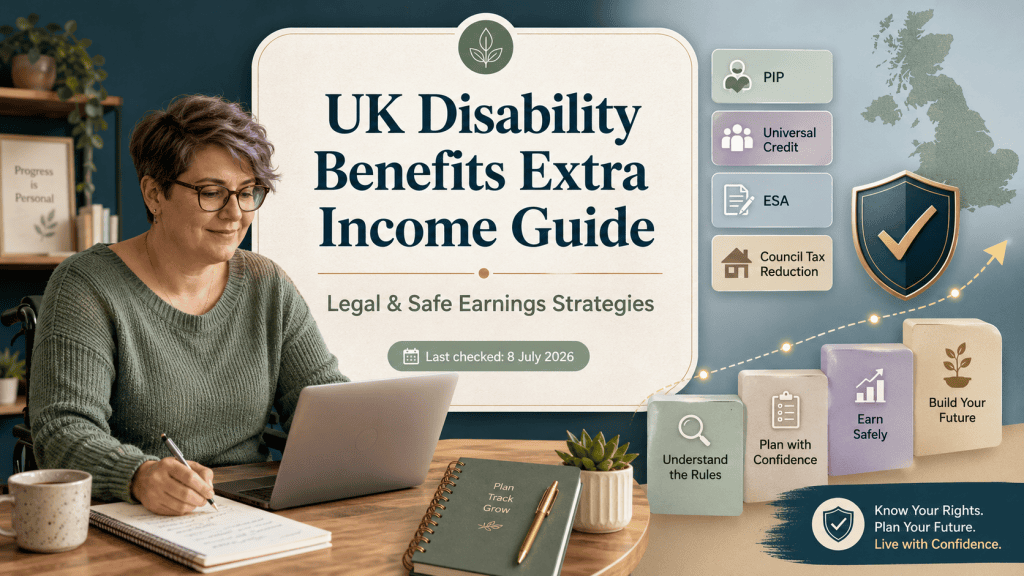
PIP is not means-tested. Universal Credit reduces gradually as your earnings rise. ESA still has permitted work rules with weekly earnings and hours limits. Council Tax Reduction is handled locally, so the rules can vary depending on your council.
This guide gives you the key 2026 figures, the safest ways to think about extra income and the mistakes to avoid before you start.
For a fuller planning guide, read our article on income planning for disability benefits in 2026
UK Disability Benefits Extra Income Guide
Quick answer: what can you earn in 2026?
Here are the main rules at a glance.
PIP: Not directly affected by earnings. PIP is based on how your condition affects daily living and mobility, not how much you earn.
Universal Credit: Earnings can reduce UC through the taper. The reduction is usually 55p for every £1 earned above your work allowance.
UC work allowance with housing costs: £427 per month before UC starts to reduce, if you qualify for a work allowance.
UC work allowance without housing costs: £710 per month before UC starts to reduce, if you qualify for a work allowance.
ESA permitted work: Less than 16 hours per week and no more than £203.50 per week after tax and National Insurance.
UC capital rules: Below £6,000 normally has no effect. £6,000 to £16,000 reduces UC. Over £16,000 usually ends entitlement.
Rent-a-Room tax threshold: Up to £7,500 per year tax-free from letting furnished accommodation in your home. This is a tax rule, not a benefit rule.
These figures can change each April. Always check the current GOV.UK figures or speak to a welfare rights adviser before making a major income decision.
Start here: check which benefits you actually receive
Before you earn more money, check your current benefits.
This matters because the rules are not the same.
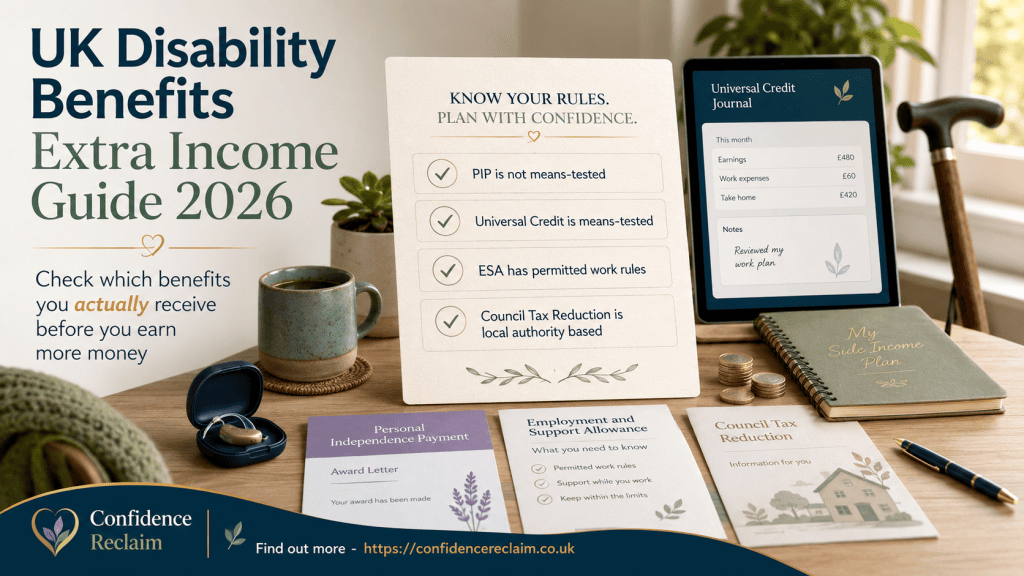
PIP is not means-tested.
Universal Credit is means-tested.
ESA has permitted work rules.
Council Tax Reduction is set by your local authority.
Do not assume that one rule applies to every benefit. A person can work while receiving PIP, but that does not mean their Universal Credit will stay the same. A person on ESA may be allowed to do permitted work, but they still need to stay within the permitted work limits.
Check your award letters, your Universal Credit journal or your most recent DWP correspondence. If you are unsure, ask Citizens Advice, Turn2us, Scope or a local welfare rights adviser.
UK Disability Benefits Extra Income Guide
PIP and extra income in 2026
Personal Independence Payment, usually called PIP, is not based on your income, savings or employment status.
You can work part-time, work full-time, be self-employed or have savings and still receive PIP, as long as you meet the disability-related criteria.
Your PIP award is based on how your condition affects your ability to manage daily living activities and mobility tasks. It is not reduced because you earn wages.
There is one practical caution.
If your work activity appears to contradict the difficulties described in your PIP claim, it could be relevant if your award is reviewed. For example, if your claim says you have severe mobility difficulties, but your job involves regular physical activity, the DWP may ask whether your award still reflects your needs.
That does not mean you cannot work.
It means your work, your health evidence and your PIP claim should be consistent and honest.
Universal Credit and earnings in 2026
Universal Credit is affected by earnings.
There is no fixed limit on the number of hours you can work while claiming Universal Credit. Instead, UC uses a monthly calculation.
For every £1 you earn from work, your Universal Credit usually goes down by 55p. This is known as the taper rate.
Some people get a work allowance. This means they can earn a set amount each month before the 55p taper starts.
You may get a work allowance if you or your partner are either:
- responsible for a child or qualifying young person
- living with a disability or health condition that affects your ability to work
If you qualify for a work allowance, the 2026/27 figures are:
- £427 per month if your UC includes help with housing costs
- £710 per month if your UC does not include help with housing costs
If you do not qualify for a work allowance, your UC usually starts reducing from the first pound of earnings.
Example: UC work allowance with housing costs
Say your work allowance is £427 per month because your UC includes housing costs.
You earn £627 in one assessment period.
The first £427 is ignored.
The remaining £200 is affected by the 55p taper.
Your UC is reduced by £110.
You still keep £90 of the £200 earned above your allowance, plus the £427 that was ignored.
This is why earning more does not usually mean losing your whole UC award at once. It usually means your UC reduces gradually as your earnings rise.
How to report earnings on Universal Credit
If you are employed, your employer usually reports your wages to HMRC through Real Time Information. Those figures normally feed into your Universal Credit account.
Still, check your journal.
Mistakes can happen, especially if you are paid weekly, paid early because of a bank holiday, receive a bonus or change your hours.
If you are self-employed, you must report your income and allowable expenses through your Universal Credit account every monthly assessment period.
Keep simple records:
- dates you worked
- payments received
- expenses claimed
- invoices
- receipts
- screenshots of journal entries
The risk is usually not earning. The risk is earning and not reporting it properly.
ESA permitted work in 2026
If you claim Employment and Support Allowance, including New Style ESA or older ESA claims, different rules apply.
For 2026/27, ESA permitted work generally means you can:
- work less than 16 hours per week
- earn no more than £203.50 per week after tax and National Insurance
- keep your normal ESA if the work meets the permitted work rules
GOV.UK currently says there is no limit on the number of weeks you can do permitted work or supported permitted work, as long as the conditions are met.
Before you start work, you should complete the permitted work form PW1 and send it to the address shown on your ESA letters. If you cannot do this before starting, send it as soon as possible.
Do not rely on old 52-week permitted work wording without checking current guidance. This area has changed over time, and outdated advice can cause confusion.
Freelance or self-employed work
Freelance work can be a good fit for some disabled people because it may offer more control over hours, energy and workload.
Examples include:
- writing
- bookkeeping
- design
- tutoring
- virtual assistance
- consulting
- photography
- craft work
- admin support
- offer promotion
UK Disability Benefits Extra Income Guide

Under Universal Credit, self-employed earnings are reported monthly. Your profit, not just your income, is what matters. That means you usually report what you received and deduct allowable business expenses.
The work allowance and 55p taper can still apply to self-employed earnings.
There is one extra rule to understand: the Minimum Income Floor.
If the DWP decides you are gainfully self-employed, and your start-up period has ended, it may treat you as earning a minimum amount even if your actual earnings are lower. The Minimum Income Floor does not normally apply if you are not expected to look for work, but this depends on your UC work group and circumstances.
Before relying on self-employment income, check your UC journal or ask a welfare rights adviser what work-related group you are in.
Selling online: eBay, Vinted, Etsy and similar platforms
Selling your own unwanted items is usually different from running a business.
If you sell old clothes, furniture, books or electronics that you already owned, this is usually treated as selling personal possessions. It is not normally the same as trading income.
But if you buy items to resell, make goods to sell regularly or run an online shop, that may be treated as self-employment.
The HMRC trading allowance lets you earn up to £1,000 of trading income in a tax year before you need to pay tax on that trading income. But this is a tax rule. It is not a Universal Credit disregard.
If you are doing regular trading while claiming Universal Credit, you may still need to report it through your UC account even if the amount is below the HMRC tax threshold.
The safe rule is simple: occasional personal sales are usually different from business activity. If it looks like a business, treat it like one and get advice.
Renting out a room
The Rent-a-Room Scheme allows you to earn up to £7,500 per year tax-free from letting furnished accommodation in your home. If you share the income with someone else, the threshold is usually £3,750 each.
For Universal Credit, rent from a non-family lodger in your home is generally not treated as income, so it should not reduce your UC.
But there are still things to check before taking in a lodger.
You may need permission from your landlord, mortgage provider or freeholder. You should also check your home insurance, Council Tax position and whether any HMO rules could apply.
If you currently receive the 25 percent single person Council Tax discount, taking in a lodger could remove that discount unless an exception applies.
If you rent from a council or housing association and have a spare room deduction, often called bedroom tax, getting a lodger may not remove that deduction under Universal Credit.
This is a good example of why you should check the whole picture, not just the income figure.
Savings, ISAs and Premium Bonds
Savings and investments can affect Universal Credit through the capital rules.
The key thresholds are:
- under £6,000: normally no effect on UC
- £6,000 to £16,000: UC is reduced using tariff income
- over £16,000: you are usually not entitled to UC
The tariff income rule means UC is reduced by £4.35 per month for every £250, or part of £250, between £6,000 and £16,000.
ISAs still count as capital for Universal Credit. Premium Bonds also count as capital.
The important point is not only the interest or prize money. It is the total amount of capital you hold.
PIP is different. Savings and capital do not reduce PIP.
Charity payments, gifts and voluntary support
Some payments from charities, friends or family may be disregarded for Universal Credit, especially where they are genuinely voluntary and not payment for work or services.
But be careful with regular arrangements.
If money is paid in return for work, services, rent, trading activity or business activity, it may be treated differently. Keep records and get advice if the payments are regular, large or unclear.
Council Tax Reduction
Council Tax Reduction is not the same everywhere.
Each local authority sets its own scheme, so the effect of earnings, savings, PIP and household changes can vary depending on where you live.
If your income changes, check your council’s rules directly. Do not assume that your UC treatment and Council Tax Reduction treatment will be identical.
UK Disability Benefits Extra Income Guide
What not to do
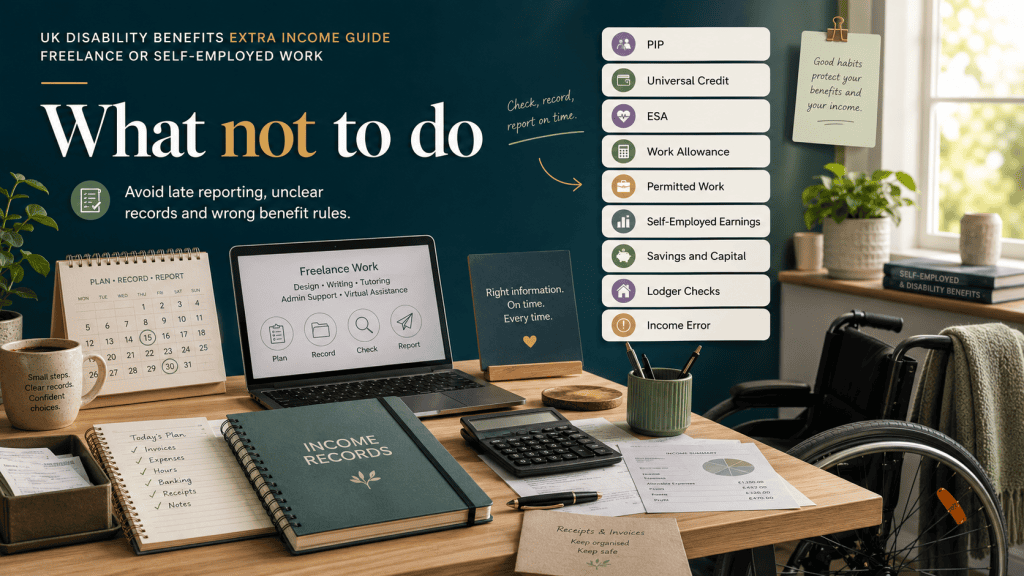
Avoid these common mistakes:
- assuming PIP rules apply to UC
- assuming UC rules apply to ESA
- using last year’s work allowance figures
- using old ESA permitted work limits
- forgetting to report self-employed earnings
- treating regular online selling as casual personal sales
- ignoring savings and capital thresholds
- taking in a lodger without checking housing, insurance and Council Tax issues
- waiting until the DWP contacts you before correcting an income error
Most problems come from late reporting, unclear records or applying the wrong benefit rule.
UK Disability Benefits Extra Income Guide
What to do before earning extra income
Before you start, take these steps.
- Confirm exactly which benefits you receive.
- Check whether you have a Universal Credit work allowance.
- Check your ESA permitted work rules if you claim ESA.
- Keep a simple record of income, hours and expenses.
- Report earnings on time.
- Save screenshots or copies of anything you send to the DWP.
- Check local Council Tax Reduction rules.
- Get advice before making a major change.
Useful places to start include Citizens Advice, Turn2us, Scope, Disability Rights UK and your local welfare rights service.
UK Disability Benefits Extra Income Guide
Frequently asked questions
Can I work and still receive PIP?
Yes. PIP is not reduced because you work or earn money. Your award is based on how your condition affects daily living and mobility. The practical issue is whether your work activity is consistent with the difficulties described in your claim.
How much can I earn on Universal Credit in 2026?
There is no simple earnings limit for Universal Credit. If you qualify for a work allowance, you can earn £427 per month before UC reduces if you get housing support, or £710 per month if you do not. After that, UC usually reduces by 55p for every £1 earned.
If you do not qualify for a work allowance, the 55p taper usually applies from the first pound of earnings.
How much can I earn on ESA permitted work in 2026?
For 2026/27, the ESA permitted work limit is less than 16 hours per week and no more than £203.50 per week after tax and National Insurance.
You should complete form PW1 before starting work where possible.
Does selling on Vinted or eBay affect Universal Credit?
Occasional sales of your own personal possessions are usually different from running a business. But if you buy items to resell, make goods to sell or sell regularly as a trading activity, this may count as self-employment and may need to be reported.
Does a lodger affect Universal Credit?
If the lodger is not a family member, rent from a lodger in your home is generally not treated as income for Universal Credit. But it can still affect Council Tax, tenancy permissions, insurance and housing rules.
Do savings affect PIP?
No. Savings do not reduce PIP.
Do savings affect Universal Credit?
Yes, if your capital is over £6,000. Capital between £6,000 and £16,000 reduces UC. Capital over £16,000 usually means you cannot get UC.
UK Disability Benefits Extra Income Guide
Final thought
You do not have to avoid earning money just because you claim disability benefits.
You do need to know which rules apply to you.
PIP, Universal Credit, ESA and Council Tax Reduction all work differently. Once you understand the difference, it becomes much easier to make safe, informed choices.
At Confidence Reclaim, we help people understand disability benefits, money worries and practical next steps with more confidence. Start with our guide to income planning for disability benefits in 2026 if you want a more detailed plan.
Ambition
If you have ambition but currently feel held back or face a lack of opportunities, then ‘The Confidence Regain Graduated Income Plan’ may be your ideal next step.
Find more details here –
‘The UK – “Benefits-Safe” Income Method Politicians Can’t Touch’