compare disabled selling vinyl records and confidence reclaim starter pack
Can Disabled People Earn Extra Income Selling Vinyl?
Is Selling Vinyl Records a Viable Income Option for Disabled People?
Overview
Selling vinyl records can provide useful extra income for some disabled people, particularly those who already own a collection, understand the market or can access suitable stock at low prices.
However, building an ongoing vinyl resale activity involves more than placing records online. It requires sourcing, identifying, grading, storing, packing and posting physical products.
For a disabled person asking, “What can I do to earn extra income?”, vinyl selling is a possible option, but its suitability depends heavily on health, mobility, available space, specialist knowledge and access to affordable records. For many beginners, a guided digital opportunity such as ‘The Confidence Reclaim Starter Pack’ may present fewer practical barriers.
Why this question matters
When disability changes what you can do for work, the first question is not always:
What job can I get?
Often, it is:
What can I realistically do now?
You may need something that can fit around pain, fatigue, medical appointments, anxiety or a condition that changes from one day to the next.
You may be able to work for short periods, but not guarantee fixed hours.
You may want to earn extra income, but need to understand the demands of an opportunity before investing your energy, money or confidence in it.
This is why generic lists of side-income ideas are not enough.
An opportunity may sound flexible but still require travel, lifting, storage, customer deadlines or money tied up in stock.
The right question is not simply whether someone can make money selling vinyl records.
The better question is:
Could selling vinyl records realistically work around my disability and personal circumstances?
Two different ways to make money from vinyl
It is important to separate two activities that are often treated as though they are the same.
Selling a collection you already own
You may have records stored at home that you no longer use.
They may belong to you, have been inherited or form part of a collection you now want to reduce.
Selling these records can create a useful one-time sum of money.
Because you already own the stock, you do not need to spend money sourcing products before you begin. Your main tasks will include:
- Identifying each record and edition
- Checking its condition
- Researching likely selling prices
- Photographing it
- Creating a listing
- Packing and dispatching it after a sale
This can be a reasonable option if the records are desirable and in suitable condition.
However, once the collection has been sold, that source of income ends.
Selling an existing collection is therefore better understood as converting an asset into money, rather than building a continuing income activity.
Buying vinyl to resell for profit
An ongoing vinyl business operates differently.
You must repeatedly find records at a price low enough to leave a profit after selling costs.
Possible sourcing routes include charity shops, car boot sales, record fairs, online auctions, house clearances and private collections.
This creates the central difficulty.
The records that are easiest to obtain are not always the records buyers want. Common titles may sell slowly or produce little profit after fees, postage and packaging.
More desirable records are harder to find. Other sellers may already be searching the same charity shops, sales and online listings.
The viability of an ongoing resale activity therefore depends less on whether vinyl is popular and more on whether you can secure a reliable supply of worthwhile stock.
What work is involved?
Selling vinyl is often described as an online or home-based opportunity.
That is only partly true.
The listing and research can usually be completed from home. The complete process may also involve physical and time-sensitive tasks.
Identifying records
Different editions of the same album can have very different values.
A seller may need to check:
- Catalogue numbers
- Label details
- Matrix or run-out information
- Country of manufacture
- Pressing year
- Sleeve variations
- Included inserts
- Whether the record is an original pressing or reissue
This requires close attention to detail.
Grading the condition
Collectors expect records to be graded accurately.
A record may appear clean but contain scratches, surface noise or warping. The sleeve may have creases, splits, water damage or missing inserts.
Grading can be subjective. A buyer may disagree with the description and request a return or refund.
Visual impairments, difficulties with concentration or conditions affecting detailed handling may make this stage more demanding.
Cleaning and photographing
Records may need to be cleaned before they are assessed and listed.
Clear photographs are also important. Buyers may want to see the sleeve, labels, inserts and any defects.
Storing inventory
Vinyl records are physical products.
They require suitable storage and can become heavy when stored in boxes or larger collections.
A continuing resale activity may require space for:
- Unsold records
- Packaging materials
- Cleaning equipment
- Returned items
- Orders waiting to be dispatched
This may be difficult in a small home or where clear space is needed for mobility equipment.
Packing and posting
Vinyl requires protective packaging.
Once an order is placed, the work becomes less flexible. The seller has made a commitment to locate, pack and dispatch the record within the promised period.
Someone with fluctuating health may be able to pause research and listing. It is harder to pause when a buyer is waiting for an order.
Advantages of selling vinyl records
Vinyl selling does have genuine strengths.
It can be completed in stages
Research, photography and listing do not always need to happen at the same time.
Someone may be able to work in short periods according to their energy.
Much of the work can happen at home
Online marketplaces allow sellers to reach buyers without running a shop or market stall.
Existing knowledge can become valuable
A person who already understands artists, genres, labels or collectible pressings may have a strong advantage.
An existing collection can create relatively quick income
Where the stock is already owned, there is no need to purchase inventory before making the first sale.
It may suit someone who enjoys physical products
Some people prefer handling real items rather than working entirely through digital systems.
These strengths mean vinyl selling should not be dismissed.
For the right person, it may be enjoyable and worthwhile
The main disadvantages
The research also reveals several important limitations.
Reliable stock is difficult to secure
An ongoing seller needs a continuing supply of records that buyers want.
Cheap stock may be common, damaged or slow to sell. Better stock usually attracts more competition and costs more.
Money can become tied up
Buying records creates a financial risk before any sale occurs.
Some items may sell quickly. Others may remain listed for months or fail to sell at the expected price.
Income is unpredictable
Earnings depend on what stock is available, what buyers want and how long each record takes to sell.
A valuable record may produce a strong return, but common records may create very little net income after costs.
Every sale requires another physical item
Once a record is sold, it is gone.
To make the next sale, another record must be sourced, researched, listed and fulfilled.
Physical demands remain
Travel, lifting boxes, searching through crates, cleaning records, packing orders and visiting postal services may all be involved.
Specialist knowledge matters
Profitable reselling often depends on knowing which editions, labels and pressings are worth buying.
A beginner can learn this, but it takes time.
Customer disputes can create pressure
Arguments about condition, shipping damage, delayed delivery or incorrect identification can add stress to what initially appeared to be a quiet home-based activity.
Who might find vinyl selling suitable?
Vinyl reselling may suit someone who:
- Already owns a collection
- Has strong music or collector knowledge
- Enjoys researching physical products
- Has suitable storage space
- Can manage packing and dispatch
- Has access to affordable stock
- Can tolerate irregular income
- Can respond to customers within reasonable timescales
- Is comfortable learning grading and marketplace procedures
It may be less suitable for someone who:
- Has limited storage space
- Cannot lift or handle boxes comfortably
- Finds regular posting difficult
- Needs an opportunity with minimal financial outlay
- Has unpredictable flare-ups that may interrupt fulfilment
- Finds detailed visual grading difficult
- Does not want money tied up in stock
- Needs a more guided starting process
Overall viability rating
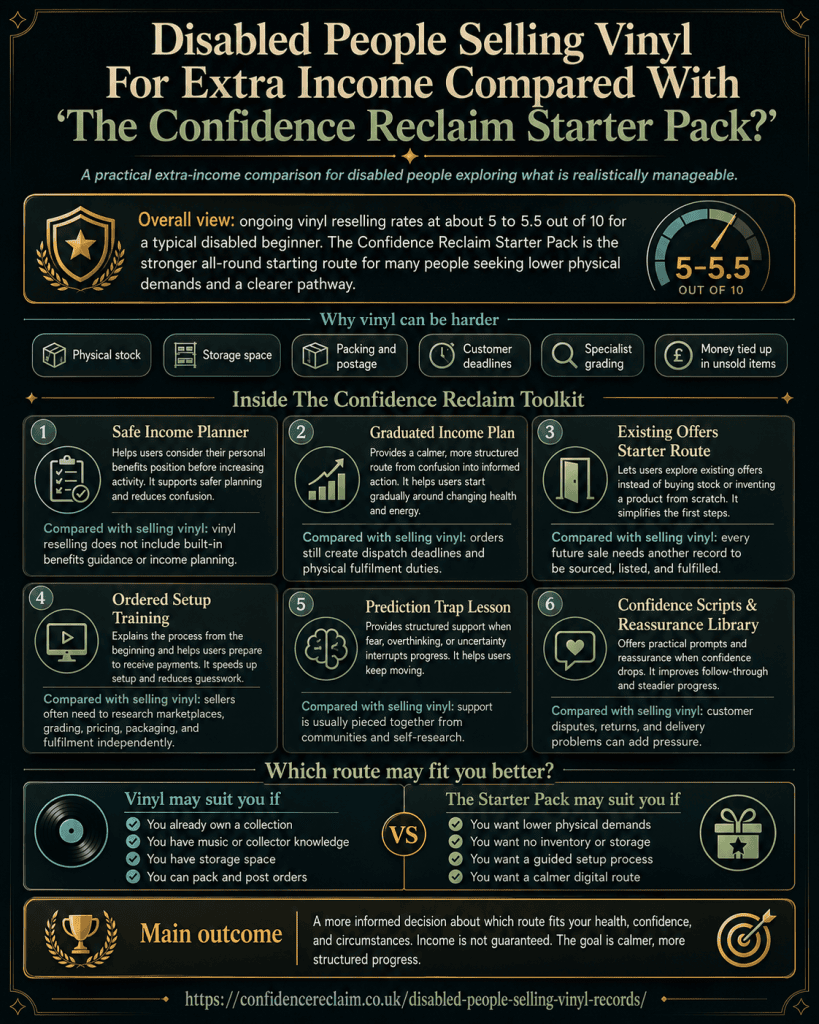
The uploaded assessment gives ongoing vinyl reselling an overall viability rating of approximately 5 to 5.5 out of 10 for a typical disabled beginner.
Selling an existing personal collection may rate higher as a one-time activity because there is no need to source new stock.
How does selling vinyl compare with ‘The Confidence Reclaim Starter Pack?’
I created ‘The Confidence Reclaim Starter Pack’ for disabled people and people with long-term health conditions who want to explore additional income but need a calmer and more structured way to begin.
The Starter Pack first helps the user consider their personal benefits position.
It then introduces a flexible online offer-promotion opportunity and guides the user through the practical setup stages.
The aim is not to promise income or suggest that every opportunity will suit every person.
It is to help the user move from confusion into informed action.
|
Comparison question |
Selling vinyl records |
The Confidence Reclaim approach |
|
Can it fit around changing health? Why it matters: A disabled person may not have the same capacity every day. |
Research, photography and listing can be flexible. Once an order is placed, the seller must pack and dispatch it within the promised period. |
Learning and setup can be completed gradually, according to the user’s available time and energy. |
|
Can the activity be completed from home? Why it matters: Travel may be difficult, exhausting or impossible for some people. |
Most selling activity can happen online. Sourcing records and taking parcels to a postal service may still require travel. |
The opportunity is primarily online and does not depend on visiting shops, record fairs or car boot sales. |
|
Is physical handling required? Why it matters: Lifting, cleaning, packing and moving products may create barriers. |
Records must be inspected, cleaned, stored, packed and posted. Boxes of vinyl can also become heavy. |
No physical stock, product cleaning, packing or postal fulfilment is required. |
|
Is startup money needed? Why it matters: Spending money before earning can create financial pressure. |
Selling an existing collection may involve little initial cost. Ongoing reselling usually requires money for stock, packaging, cleaning materials and travel. |
Users do not need to purchase physical inventory before they can begin exploring existing offers. |
|
Is a continuing supply of stock required? Why it matters: Income may stop when suitable products cannot be found at a profitable price. |
Every future sale requires another record to be sourced. Affordable and desirable stock can be difficult to find consistently. |
The opportunity does not depend on repeatedly finding physical products below their market value. |
|
Is storage space needed? Why it matters: Stock can occupy living space and may need special storage conditions. |
Space is required for records, packaging materials, cleaning equipment and items waiting to be dispatched. |
No physical product storage is required. |
|
Is specialist knowledge required? Why it matters: A long learning curve may delay progress and increase the risk of mistakes. |
Pressing identification, grading, pricing and collector knowledge can be important, particularly when buying stock to resell. |
The Starter Pack explains the process from the beginning and does not assume previous business experience. |
|
Does the user need to invent or create a product? Why it matters: Creating an original product or business idea can stop someone before they begin. |
The seller must find, assess and prepare a suitable physical product for every sale. |
Existing offers can be explored, so the user does not need to invent a product from nothing. |
|
Does each payment require a new item or task? Why it matters: Some income models begin again from zero after every transaction. |
Once a record is sold, another record must be sourced, researched, listed and fulfilled. |
An offer can remain available after its initial setup, although continued promotion and effort may still be required. |
|
Is the setup process guided? Why it matters: Disconnected information can create confusion and delay action. |
The seller will usually need to research marketplaces, grading, pricing, packaging and fulfilment independently. |
The course provides an ordered setup process and helps users prepare to receive payments. |
|
How predictable is the income? Why it matters: Irregular income can make financial planning difficult.
|
Income depends on stock availability, condition, buyer demand and how long each record takes to sell. |
Income is not guaranteed, but activity is not limited by the need to find and purchase a new physical item for every sale. |
|
Are customer service and fulfilment obligations involved? Why it matters: Returns, disputes and delivery problems can add pressure.
|
The seller may need to deal with grading disputes, damaged parcels, late deliveries, refunds and returns. |
There is no physical delivery or product grading, although users must still follow platform rules and communicate responsibly. |
|
Can the activity grow without an equal increase in physical work? Why it matters: Some opportunities require more stock, storage and handling as sales increase. |
Growth usually means sourcing, storing, packing and posting more records. It may also require more working capital. |
Digital offer promotion can grow without an equivalent increase in physical fulfilment, although active work is still required. |
|
Does the opportunity include benefits planning? Why it matters: Extra income should be considered alongside the user’s individual benefits position.
|
Vinyl reselling does not provide built-in benefits guidance or income planning. |
The Safe Income Planner and Graduated Income Plan help users consider their position before increasing activity. |
|
What support is available when confidence drops? Why it matters: Fear and uncertainty can interrupt progress even when the practical route is clear. |
Support depends on the marketplace, seller communitiesor informationthe individual finds independently. |
The free Prediction Trap lesson and Confidence Scripts and Reassurance Library provide structured support. |
Which is the better all-round option?
Selling vinyl records can be a good choice in certain circumstances.
If you already own a worthwhile collection, selling it may produce useful one-time income.
If you have detailed music knowledge, suitable storage and an established way to obtain undervalued stock, you may also be able to develop an ongoing resale activity.
However, for a typical disabled beginner seeking a flexible supplementary income route, vinyl selling has several structural barriers:
- Physical stock
- Storage requirements
- Sourcing costs
- Packing and postage
- Customer deadlines
- Specialist grading knowledge
- Money tied up in unsold items
- The need to find a new item for every sale
The Confidence Reclaim route removes many of those barriers.
It does not require physical inventory, storage, cleaning or postal fulfilment.
It also begins with personal planning and a guided setup process rather than leaving the user to assemble the route alone.
For these reasons, I consider The Confidence Reclaim Starter Pack the stronger all-round starting opportunity for many disabled people who want to explore extra income with lower physical demands and a clearer pathway.
That does not mean it is automatically right for everyone.
The purpose of the comparison is to help you understand the differences, consider your own circumstances and make a more informed decision.
What should you consider before choosing?
Before beginning any income activity, ask:
- Can I complete the full process around my health?
- What happens on a bad day?
- Will customers be waiting for me?
- Do I need money before I can start?
- Could that money become tied up?
- Will I need storage?
- Is travel involved?
- Do I need specialist knowledge?
- Is the income one-time or potentially repeatable?
- Does the opportunity help me consider my benefits position?
- Will I receive a clear setup path?
- Can I begin gradually?
The best opportunity is not necessarily the one with the most exciting income claim.
It is the one you can realistically begin, continue and manage around your life.
A calmer next step
I created The Confidence Reclaim Starter Pack because I know what it feels like when disability changes your working life, income, confidence and sense of control.
The Starter Pack is designed to help people who want to explore extra income begin with clearer information, practical tools and manageable steps.
[Read what The Confidence Reclaim Starter Pack is and who it is for]
From there, you can decide whether it offers a better fit for your circumstances.
The Confidence Reclaim Starter Pack provides educational guidance, planning tools and practical structure. It does not guarantee earnings or replace qualified welfare rights, legal, financial, tax or benefits advice.